

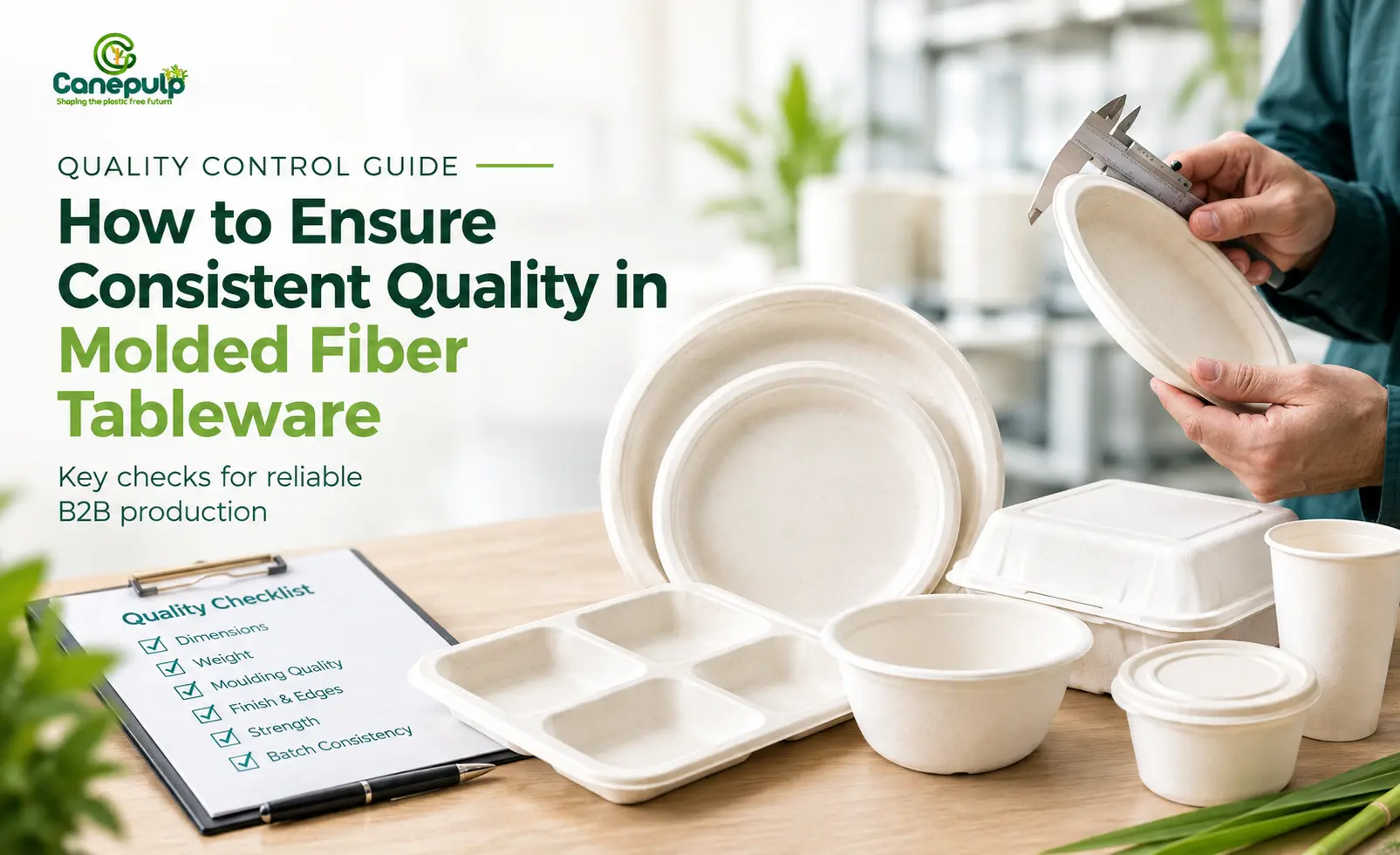
A molded fiber tableware buyer can receive two quotations that look similar on paper and still face very different commercial outcomes because the product quality depends on more than a single sample or a generic product image. In B2B sourcing, quality control is not just a factory formality. It is the system that helps protect product specification, repeatability, batch consistency and customer expectations when the order moves from initial approval into large-volume production. For buyers evaluating molded fiber or sugarcane bagasse tableware, the important question is not simply whether the product looks good in a photo. It is whether the supplier has a practical, documented process for keeping the production output consistent with the agreed specification.
1. Start With a Clear Product Specification
A buyer cannot evaluate quality properly without a clear product specification. The specification should be specific enough that the supplier and the buyer both understand what is being produced, how it will be judged, and what would count as a variation from the agreed standard. For molded fiber tableware, that can include dimensions, depth, weight where relevant, capacity, product construction, compartment configuration, visual finish expectations and the intended foodservice application.
This is crucial because a product can be described in a general way and still be commercially different from the item that the buyer actually needs. “The product looks like the sample” is not the same as “the product conforms to the agreed specification.” In B2B procurement, the second statement is the more useful one. It connects the sample, the commercial requirement, and the production output in a way that supports repeat orders and reduces quality surprises after the shipment has already left the factory.
The specification should be treated as a commercial reference, not as a casual note in a supplier email. If the buyer is placing a recurring order or a private-label program, this is even more important because the product definition has to remain stable across production runs. Detailed specification review is one of the most practical ways to reduce risk before bulk production begins.
2. Sample Approval Is Only the Starting Point
Sample approval is an important stage, but it is not the end of the quality-control process. A sample can confirm that a design or concept works, but it does not automatically guarantee that future production runs will match the product exactly. The buyer should treat the approved sample as a reference point rather than a final promise that all future quantities will be identical in every measurable way.
The practical issue is repeatability. A buyer should ask how the approved sample is used during the production phase, which product characteristics are compared to the sample, and how differences are identified and handled. The buyer may want to review dimensions, weight, moulding quality, edges, compartment geometry, finish, stacking behavior and visible defects against the approved sample or the product specification. This helps the buyer understand whether the sample is a true benchmark or simply a one-off reference that did not translate well into production.
For repeat orders, this is a critical distinction. A buyer needs to know not only whether the sample looked good, but whether the supplier can produce the same commercial standard again and again when volume increases. That is where quality-control practices become more important than a single successful sample approval.
3. What Should Be Checked During Production?
From a buyer’s perspective, quality control during production should answer a practical question: is the product still on-spec as it moves through processing and before it is shipped? The exact checks will vary by SKU and buyer requirements, but there are a few categories that matter consistently for molded fiber tableware.
Dimensions are often one of the first checks. The buyer may review whether the product remains within the required shape, size and profile for the approved specification. Weight is also relevant when it is part of the product definition or when a buyer wants to verify consistency across batches. Moulding quality matters because visible deformities, inconsistency in compartments, uneven edges, or poor shape control can signal deeper issues in the forming process. Finish and edge quality are also important because they affect appearance and usability. Strength and handling behavior should be assessed according to the buyer’s real use case, especially for foodservice or repeated distribution conditions.
The buyer should think about quality checks as part of a wider product control system rather than as a list of visual criteria. A strong production-quality process helps reduce variation between batches, keeps the item closer to the approved specification, and gives the buyer a clearer way to hold suppliers accountable when differences appear. The buyer should ask what is checked, when it is checked, and how deviations are handled, rather than taking a vague commitment to “quality” at face value.
4. Food Performance Should Match the Intended Use
A molded fiber tableware product should be evaluated against the real operating environment it is meant to serve. A plate used for hot food, oily food, gravy-based items, dry service, takeaway distribution or catering may have different performance expectations than a generic tableware item used in a less demanding environment. That is why quality control should be connected to the buyer’s real use case, not only to a product photo or a one-off sample review.
For example, a product can look consistent and still perform differently when it is filled with hot food, stacked, transported, or used in a high-turnover service setting. Buyers may therefore want to review how the product behaves in situations the business actually faces, such as stacking, handling, product stability, and service conditions. This is not about making unsupported guarantee claims. It is about validating that the product is suitable for its intended use and aligned with the specification the buyer actually needs.
A good quality-control conversation therefore includes the intended food application, not just the product appearance. The buyer should ask what conditions matter most for the order and which checks are used to confirm performance before the order is approved in large volume. This helps buyers move from a purely visual sample review to a more commercially realistic assessment of quality.
5. Batch-to-Batch Consistency Matters More Than a Perfect Sample
A strong sample is useful, but recurring B2B supply depends on whether the supplier can reproduce the approved specification consistently. A supplier may produce an attractive sample once, but that does not guarantee the same dimensions, weight profile, moulding quality, finish, and product behavior will remain stable once the order is scaled. Batch consistency is often more important than a single perfect sample because the buyer’s commercial risk is not limited to the first production run.
This distinction is especially important for foodservice buyers, private-label buyers, importers, wholesalers, and distributors because a repeat order needs reliable product behavior. If product geometry changes from batch to batch, or if finish and moulding quality vary, the buyer may have problems with packaging, handling, customer presentation, or product specification control. In these cases, the issue is not only how the sample looked. It is whether the supplier can reproduce the agreed commercial standard at scale.
The buyer should therefore evaluate quality across the production life cycle: sample approval, production comparison, final inspection and repeat-order tracking. That approach gives a much more realistic picture of supplier capability than judging the sample in isolation. A reputable or capable supplier should be able to explain how it keeps the approved specification stable across repeat production, not only how a first sample performed.
6. Packaging Is Part of Product Quality
Quality control does not always end in the factory. Packaging and delivered-condition quality also matter. A molded fiber product can meet production specifications but still be damaged during stacking, transport or handling if the carton configuration is not suitable or if the shipment is not protected properly. This is especially relevant for exporters, importers and wholesale buyers who manage large quantities or longer transit times.
For a buyer, packaging is part of product quality because it affects how the product arrives and whether the item remains commercially usable. Relevant considerations may include carton dimensions, piece count, load protection, stacking, moisture exposure during transport, and whether the box protects the product through arrival and handling. A quality review without packaging considerations can miss an important part of the real commercial risk.
This is also where manufacturing quality and delivery quality should be seen as distinct but connected topics. The product may be correctly made, but the shipment can still be compromised if the packaging or logistics process is poorly controlled. That is why a B2B buyer should ask how packing and handling are managed in addition to the more obvious manufacturing checks.
7. Ask the Supplier These Quality-Control Questions
- What specification is used for the production batch?
- How is the approved sample referenced during production?
- Which product characteristics are inspected?
- When are inspections performed?
- How are dimensional or weight variations handled?
- How are non-conforming products managed?
- What is the process for repeat-order consistency?
- How are buyer concerns documented and resolved?
- What packing and shipment controls are applied?
- What documentation is available for reference and quality review?
These questions matter because they move the conversation from general quality claims to practical buyer control. A supplier that can give clear, specific answers is often easier to manage in a repeated commercial relationship. A supplier that relies on vague statements about “quality” without explaining what is checked and how it is controlled creates a much higher procurement risk.
8. Quality Control for Recurring B2B Orders
Quality control becomes even more important when a buyer is moving into recurring production or a larger volume order. At that stage, the supplier’s ability to maintain the same product specification matters more than the initial sample approval alone. Buyers should think about how product revisions are tracked, how approved sample records are retained, how packaging stays consistent, and how product changes are communicated before a new order is released.
This is also where documentation becomes useful. A buyer may want to keep a record of the product specification, sample approval, inspection notes, packing details and any product or design revisions that were accepted. That helps maintain a more stable procurement process and reduces ambiguity when repeat orders are placed over time. A supplier can support that process by being clear about the checks they perform and the information they can provide for a commercial order.
A realistic B2B quality-control system is therefore a combination of technical checks, production discipline, change control and orderly communication. It is not merely the existence of a sample or a quality statement on a webpage. It is the buyer’s ability to see that the product is repeatedly produced to the agreed standard and can be traced through the commercial process.
Bulk Order Buyer Checklist
- Product specification confirmed
- Approved sample retained as a reference
- Dimensions checked against specification
- Weight or batch consistency reviewed
- Moulding quality inspected
- Edge and finish checked
- Handling and intended food use reviewed
- Packaging and delivered-condition quality considered
- Repeat-order control discussed
- Inspection and documentation clarified
Review Quality Control Before Approving a Bulk Order
Before committing to a molded fiber or bagasse tableware order, confirm the product specification, production checks, and repeat-order controls with your supplier.
Quality control for molded fiber tableware should be evaluated as a system that connects specification, sample approval, production checks, batch consistency, product performance, packing and repeat-order management. A buyer should not rely on a single sample or a visual impression. The better approach is to review the product against the agreed commercial specification, understand what is being checked during production, and confirm how the supplier handles repeat-order consistency. That is how a B2B buyer moves from a simple product review to a more practical and reliable procurement decision.