

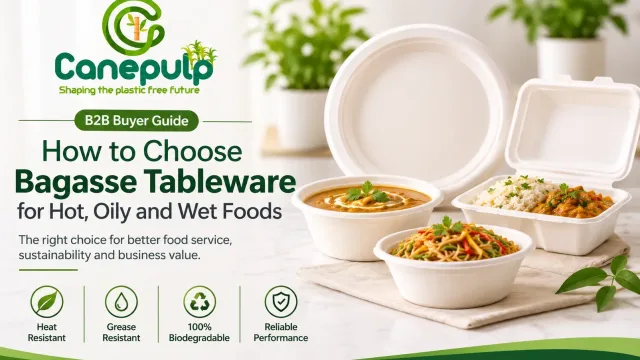
Choosing bagasse tableware for hot, oily and wet foods requires more than selecting a product by material name, shape or appearance. Plates, bowls, trays and food containers can perform differently depending on their dimensions, fiber structure, weight, geometry, intended application and the food they are designed to carry. For restaurants, caterers, foodservice distributors, importers and wholesalers, the right purchasing decision should therefore start with the actual menu and service conditions. This guide explains how B2B buyers can evaluate bagasse tableware for hot, oily and wet foods, what to check during sample approval, and which questions to ask before placing a bulk order.
Start With the Food, Not Just the Tableware
The same bagasse tableware format may be used for different foods, but the operating conditions are not always the same. A dry snack, hot curry, oily fried meal, saucy rice dish and liquid-heavy food can place very different demands on a plate, bowl or container.
For B2B buyers, the first step is to define the actual food application. Consider food temperature, moisture level, oil or grease content, portion weight, holding time, transport conditions and whether the product will be stacked, delivered or reheated.
This approach is more useful than choosing a product based only on a general statement such as “suitable for food.” The exact SKU should be evaluated against the food and service conditions it will actually encounter.
1. Understand the Difference Between Hot, Oily and Wet Food Conditions
Hot, oily and wet foods are often grouped together, but they create different performance requirements. Heat can affect material stiffness and the way moisture interacts with the product. Oily foods can challenge grease resistance, while wet or saucy foods can place greater demands on structure, edges, seams and holding time.
For example, a plate used for a hot rice-and-curry meal may need to maintain its shape while carrying both moisture and oil. A bowl used for soup or a liquid-heavy meal has different containment requirements. A takeaway clamshell may also need to maintain its structure while being handled, stacked and transported.
Before comparing suppliers, document the food type and expected conditions for each SKU. This gives the manufacturer a clear basis for recommending or validating the appropriate product format.
2. Choose the Right Product Format for the Food
Product shape matters because the same material can behave differently in a shallow plate, deep bowl, compartment tray or hinged food container. Buyers should select the format according to the food being served rather than assuming that one product type can replace every other format.
Shallow plates are commonly suited to plated meals and foodservice applications where the contents can remain distributed across the surface. Deeper bowls can be more appropriate for soups, gravies, noodles, salads and other foods that benefit from greater containment. Compartment trays can separate multiple meal components, while clamshells and food containers can support takeaway and delivery applications.
When comparing products, review usable capacity, depth, compartment design, rim structure, lid compatibility and stackability alongside the nominal dimensions. A product that looks similar in a catalogue may behave differently once filled with the actual food.
Review the Canepulp bagasse tableware product range to compare plates, bowls, food containers, clamshell boxes and meal trays by intended application.
3. Check How the Product Handles Hot Foods
Hot food can create a combination of temperature, moisture, steam and structural load. Buyers should therefore avoid relying only on a generic “heat resistant” statement. The relevant question is whether the exact product is suitable for the temperature, food type and contact duration expected in the intended application.
Ask the supplier for the product specification and any available supporting information for the exact SKU. If your operation involves freshly cooked meals, hot curries, rice dishes, grilled foods or other high-temperature menu items, use those foods during sample evaluation whenever practical.
Also consider what happens after filling. A product may need to remain stable while food is served, carried across a dining area, placed into a delivery bag, stacked with other meals or held before consumption. Performance should therefore be assessed over the realistic service period rather than only immediately after filling.
For product-specific information, review the bagasse plates and relevant food-container specifications, then confirm the exact SKU and intended application with the supplier before bulk approval.
4. Evaluate Grease Resistance for Oily Foods
Oily and greasy foods create a different challenge from heat alone. Fried foods, curries, biryanis, grilled items, sauces and other high-fat meals can place greater demands on the tableware surface and structure.
When evaluating a bagasse product for oily foods, check whether the food remains contained without excessive penetration, staining or loss of structural stability during the intended service period. Do not assume that a result from one plate, bowl or container automatically applies to every product in a supplier’s catalogue.
The food itself should be part of the evaluation. A sample tested with a dry food cannot establish performance with a hot, oily curry or a sauce-heavy meal. Product design, thickness, density, surface characteristics and the actual food conditions all matter.
Canepulp’s current bagasse plate information describes applications involving oily foods and recommends evaluating the exact product and use conditions. Buyers should still confirm suitability for their own menu and SKU requirements before production approval.
5. Test Wet, Saucy and Moist Foods for Structural Stability
Wet foods can affect tableware through direct moisture exposure, sauces, gravies and prolonged contact. The important question is not simply whether a product can touch wet food, but whether it maintains the required shape, rigidity and containment during the full service period.
For plates, pay attention to the base, rim and areas where sauce or gravy may collect. For bowls, evaluate the depth, base stability and side-wall structure. For food containers, inspect the corners, lid interface, seams and areas that may experience pressure during transport.
If the food is intended for delivery, extend the test beyond the restaurant counter. Fill the sample with representative food, close it as intended, handle it normally and evaluate the product after the expected transport and holding period.
6. Test the Exact Food and Serving Conditions Before Approval
Sample approval is strongest when the test reproduces the real application. A catalogue photograph or empty sample can confirm appearance and dimensions, but it cannot fully demonstrate how the product will behave with the food it is intended to carry.
For a hot-food application, test with representative hot food. For oily applications, use the actual oily or greasy menu item where practical. For wet or saucy foods, evaluate the product after realistic contact time. If delivery is part of the application, include handling, stacking and transport simulation in the test.
Record the result for every SKU. Note product dimensions, weight where relevant, food type, approximate temperature, contact time, portion size, observations and any visible changes. This creates a useful reference when the product moves from sample approval to repeated production.
For a broader sample-approval framework, see Bagasse Tableware Sample Approval: What B2B Buyers Should Check.
7. Compare Weight, Dimensions and Structure — Not Just Appearance
Two bagasse products can have the same nominal diameter or capacity and still perform differently. Weight, wall thickness, geometry, depth, edge structure and manufacturing consistency can influence how a product behaves under foodservice conditions.
For commercial buyers, record the approved sample specification and use it as the reference for future production. If the product is intended for heavy portions or wet meals, structural stability becomes particularly important because the food load can increase the stress on the product.
The objective is not to select the heaviest product automatically. Instead, select a specification that provides the required performance for the intended application while remaining commercially suitable for your packaging, shipping and cost requirements.
See Why Weight Consistency Matters in Molded Fiber Tableware for more information about specification consistency across production.
8. Check Lid Fit and Container Compatibility for Takeaway Foods
For takeaway and delivery applications, tableware performance is not limited to the base product. A compatible lid can affect containment, handling, stacking and transport. Buyers should therefore evaluate the complete food-service system rather than approving a container and lid independently.
Check whether the lid fits securely, whether the filled container remains stable when handled, and whether the closure continues to function after the food has been filled. For saucy or oily foods, inspect the lid interface and corners because these areas can become important during transport.
If the supplier offers multiple lid options, confirm the approved lid reference in the written specification. This reduces the risk of a substitute component being supplied later without buyer approval.
For takeaway applications, review the bagasse food containers and confirm lid compatibility, product specification and intended use for the exact SKU.
9. Consider Reheating and Microwave Requirements Separately
Some foodservice programs require reheating before consumption. If microwave reheating is part of the application, treat it as a separate requirement rather than assuming that suitability for hot food automatically establishes suitability for every reheating condition.
Ask the supplier for product-specific instructions and limitations for the exact SKU. Confirm whether the base, lid or complete assembled product is covered by the guidance, because different components may have different requirements.
The buyer should also define the intended reheating method, approximate duration and food type. A realistic test should follow the actual operating process rather than an unspecified “microwave safe” assumption.
Canepulp’s food-container guidance provides product-specific microwave instructions for certain containers. Always confirm the exact SKU, component and intended reheating method before approving a product for commercial use.
10. Ask for Product-Specific Documentation and Performance Evidence
Performance claims should be connected to the specific product being purchased. Buyers should ask what documentation or test information supports the intended food-contact, compostability, grease-resistance, temperature or other performance claim.
Review the scope of any document carefully. Confirm the product or SKU covered, applicable test conditions, issuing organization, dates and any limitations. A document for one product should not automatically be treated as evidence for every product in a supplier’s catalogue.
This is particularly important for international buyers making claims to customers or regulators. Separate documented evidence from general marketing language, and confirm destination-specific requirements with the appropriate compliance or import adviser where necessary.
11. Check Storage and Transit Conditions Before the Product Reaches the Customer
Foodservice performance begins before the product is used. Bagasse tableware and its packaging can be affected by moisture and storage conditions, so buyers should consider warehousing, transportation and handling as part of the procurement plan.
For imported products, cartons may pass through different environments before reaching the distributor or end customer. Confirm the supplier’s storage guidance and inspect incoming cartons and packaging for moisture exposure, damage or other conditions that could affect product quality.
Distributors should also use suitable warehouse practices and stock rotation. A product that was approved under controlled conditions should still be protected from avoidable storage and handling problems after shipment.
See Bagasse Tableware Storage & Shelf Life: A Warehouse Guide for a deeper look at storage and moisture considerations.
12. Use a Simple B2B Food-Performance Test Sheet
A repeatable test sheet helps procurement teams compare products and suppliers using the same criteria. This is especially useful when a distributor is evaluating several bagasse plates, bowls or food containers for different menu categories.
Record the product reference, dimensions, weight where relevant, food tested, approximate temperature, portion size, contact time and observations. If the product is used for delivery, record the transport or handling simulation as well.
The purpose is not to create a laboratory certification from a kitchen test. The purpose is to create a practical application record and identify questions that require further supplier documentation or formal testing.
13. Approve the Exact SKU Before a Bulk Order
Once the product has passed the buyer’s practical evaluation, record the approved specification clearly. Include the product reference, dimensions, weight or tolerance where relevant, material requirements, packaging configuration and any agreed performance requirements.
Do not assume that approval of one product format automatically approves another. A plate, bowl, meal tray and food container may each have different specifications and food applications, even when they come from the same manufacturer.
For repeat orders, the approved sample and written specification should remain the reference point. This gives both buyer and manufacturer a clearer basis for identifying and resolving deviations.
For production consistency, see From Approved Sample to Repeat Order: How Specification Control Works.
14. Choose the Supplier Based on Verified Performance, Not a Generic Claim
The best bagasse tableware for hot, oily or wet foods is not necessarily the product with the broadest marketing claims or the lowest purchase price. The right choice is the SKU whose documented specification and practical performance match the food, service conditions and commercial requirements of the buyer.
For B2B sourcing, supplier selection should combine product performance with manufacturing consistency, documentation, packaging, MOQ, lead time and repeat-order capability. A product that performs well in a sample but cannot be supplied consistently may still create problems at commercial scale.
Use the same food-performance criteria when comparing suppliers. This makes the final sourcing decision more objective and reduces the risk of approving a product based only on catalogue photographs or general material claims.
For a broader supplier-selection framework, see How to Evaluate Bagasse Tableware Manufacturers: A B2B Buyer’s Checklist.
Practical Hot, Oily and Wet Food Checklist
- Have you identified the exact food and menu application?
- Have you defined whether the application involves heat, oil, moisture, sauce or a combination?
- Have you selected the appropriate plate, bowl, tray or container format?
- Have you checked the exact product dimensions, capacity and structural specification?
- Have you tested the product with representative food rather than only reviewing an empty sample?
- Have you evaluated the product after the expected holding or service period?
- For takeaway, have you tested the complete container and lid combination?
- Have you confirmed any reheating requirements separately?
- Have you requested product-specific documentation for relevant claims?
- Have you recorded the approved SKU and specification before placing the bulk order?
- Have you considered storage and transit conditions after production?
- Have you confirmed that the same specification can be maintained for repeat orders?
Frequently Asked Questions
Are bagasse plates suitable for hot food?
Bagasse tableware is used for many hot-food applications, but suitability should be evaluated for the exact product and intended food conditions. Temperature, moisture, food composition, portion weight and holding time can all affect performance. Buyers should confirm the product specification and test representative food before approving a bulk order.
Are bagasse plates suitable for oily or greasy food?
Some bagasse products are designed for oily and greasy foodservice applications, but performance varies by product. Test the exact SKU with representative foods such as oily meals, curries or fried foods and confirm the applicable supplier information before approval.
Are bagasse bowls better for wet foods?
A deeper bowl can provide better containment for some wet, saucy or liquid-heavy foods than a shallow plate, but product suitability depends on the exact design and intended application. Buyers should compare depth, structure, capacity and actual food performance rather than choosing by shape alone.
Can bagasse food containers be used for takeaway meals?
Bagasse food containers are used for takeaway and delivery applications, but buyers should evaluate the complete container system, including lid compatibility, food type, holding time, handling and transport conditions. The exact SKU should be confirmed for the intended application.
How should I test bagasse tableware before a bulk order?
Test the exact sample with representative food under realistic conditions. Check temperature, oil or moisture exposure, portion weight, contact time, structural stability, leakage or grease penetration where relevant, stacking and handling. Record the results and compare them with the written product specification.
Does hot food automatically mean a bagasse product is microwave safe?
No. Hot-food suitability and microwave suitability are separate requirements. If reheating is part of the intended use, confirm the exact product, component and supplier instructions for the planned microwave conditions.
Should every bagasse product from one manufacturer have the same performance?
No. Plates, bowls, trays and containers can have different dimensions, wall structures, weights and intended applications. Product-specific evaluation is important, especially when food conditions or performance requirements differ.
What should B2B buyers ask a bagasse tableware supplier?
Ask for the exact SKU specification, intended application, relevant product documentation, sample availability, packaging details, MOQ, lead time and any limitations or instructions for hot, oily, wet or reheated foods. For international orders, also confirm the documents and requirements relevant to the destination market.
Conclusion
Choosing bagasse tableware for hot, oily and wet foods should start with the real food application rather than a generic product claim. Define the temperature, moisture, oil content, portion size, contact time and handling conditions, then select the appropriate product format and evaluate the exact SKU.
For B2B buyers, the strongest process combines practical sample testing with written specifications, product-specific documentation, quality controls and repeat-order planning. This helps importers, distributors, restaurants, caterers and foodservice businesses choose products that are appropriate for their actual operating conditions.
The goal is not to find one universal bagasse product for every food. It is to approve the right product for the right application and maintain that specification consistently as the order moves from sample to commercial production.
Review the Canepulp bagasse tableware product range to identify the appropriate plates, bowls, food containers and meal trays for your application. For B2B sourcing, compare the exact SKU specification, sample performance, packaging and order requirements, then request a quote with your selected products, quantities, destination and food-service requirements.