

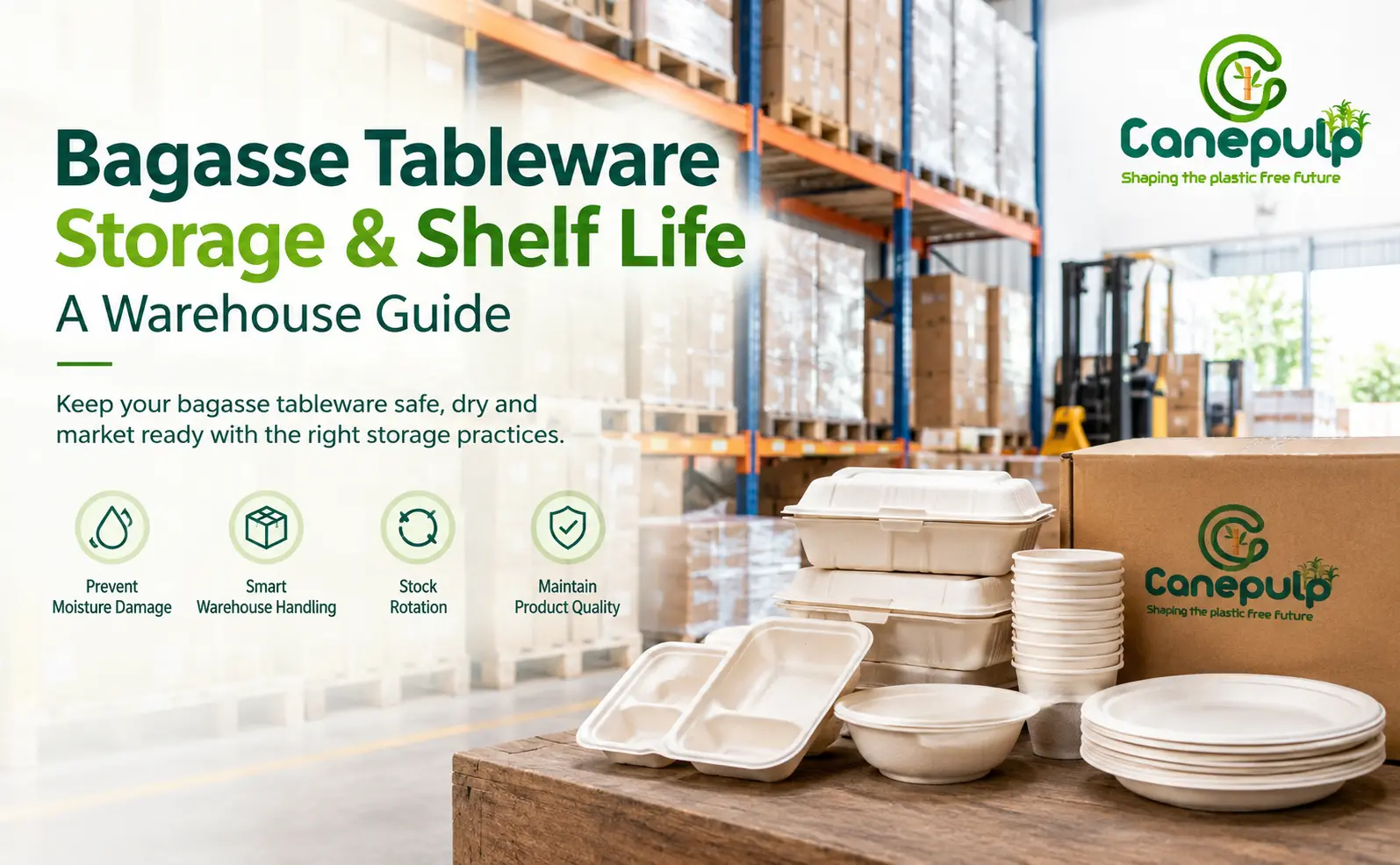
For importers, distributors, wholesalers and foodservice suppliers, protecting bagasse tableware after delivery is an important part of inventory management. Sugarcane bagasse plates, bowls, trays and food containers are made from molded plant fibers, so moisture, condensation, damaged cartons and rough handling can affect the condition of stored goods. This guide focuses on post-arrival warehousing, stock rotation and shipment-receiving controls; it is separate from manufacturing quality control and pre-shipment product inspection. For product options and commercial planning, see our bagasse tableware catalog, wholesale supply and bulk order planning. Always follow the storage instructions supplied for the specific product, as requirements can vary by design, packaging and intended use.
Bagasse Tableware Storage: Key Practices at a Glance
| Storage area | Recommended practice | Risk to avoid |
|---|---|---|
| Warehouse environment | Keep the area clean, dry and ventilated; monitor humidity where conditions are damp. | Moisture exposure and musty conditions |
| Cartons and packaging | Keep cartons closed and intact until products are needed. | Dust, splashes and accidental contamination |
| Floor and walls | Use suitable pallets or shelving and keep stock away from damp floors and leaking walls. | Water transfer into lower cartons |
| Stacking | Follow carton markings and the supplier's stacking limits; keep stacks stable. | Crushed cartons and deformed products |
| Inventory rotation | Use FIFO or FEFO where a manufacturer-defined expiry or use-by date applies. | Older stock being left behind |
| Incoming shipments | Inspect the container, cartons and a sample of inner packaging when goods arrive. | Undetected transit moisture or handling damage |
There is no single storage temperature, relative-humidity target or shelf-life period that applies to every bagasse product. Conditions depend on the product, production process, packaging, transit history and the manufacturer's validated guidance. Buyers should request written storage instructions and any applicable shelf-life information for the exact item they purchase, especially when comparing the storage standards of different suppliers or verifying product quality for a large distribution program.
Why Moisture Matters for Sugarcane Bagasse Tableware
Bagasse is the fibrous residue left after juice is extracted from sugarcane. In molded-fiber tableware, these fibers are formed into products such as plates, bowls, meal trays and takeaway containers. Like many paper-based and plant-fiber materials, bagasse products and their cartons can be affected by damp conditions.
Excess moisture may soften packaging, affect product shape or appearance, weaken carton stacking performance and create conditions that support mold growth if moisture and other favorable conditions persist. Condensation can also occur when goods move between environments with different temperatures. For bulk buyers, these risks can lead to inspection failures, repacking, stock loss or customer complaints.
- Carton damage: Damp corrugated cartons may lose strength and become more vulnerable to compression.
- Product condition: Products exposed to water or persistent dampness may lose their intended appearance or shape.
- Mold risk: Wet or persistently damp organic-fiber materials may develop visible mold or musty odors.
- Odor and contamination: Open cartons can absorb surrounding odors or be exposed to dust, spills and chemicals.
The practical objective is to prevent direct water contact, limit avoidable humidity exposure, maintain clean storage conditions and inspect stock routinely. Do not rely on a generic humidity number as a substitute for the product manufacturer's instructions, because proper bagasse tableware humidity control depends on the product design, the local warehouse environment, the shipping route and the supplier's documented handling guidance. A well-run receiving process should include inspection on arrival, checklists for warehouse staff, and a clear separation between acceptable inventory and any cartons showing water staining, odor changes or visible mold risk.
How to Set Up a Warehouse for Bagasse Tableware
A suitable warehouse for biodegradable tableware does not need to be complicated, but it should protect inventory from water, dirt, pests, excessive heat and avoidable handling damage. Establish clear storage zones, assign responsibility for routine inspections, and make moisture checks part of the staff schedule instead of an afterthought. Buyers planning repeat orders should also review wholesale bagasse tableware supply and export market guidance to align warehouse practices with commercial sourcing, import planning and post-arrival handling requirements. This makes the storage process more reliable for retail buyers, hospitality buyers and larger distribution programs alike.
1. Keep the storage area dry: Repair roof leaks, inspect doors and windows after heavy rain, and address water ingress promptly. Do not place cartons in areas where floor washing or cleaning sprays can wet the packaging. Keep a small inspection log for leaks, condensation, and any unusual atmospheric changes after storms or seasonal shifts.
2. Provide suitable ventilation: Maintain air movement and avoid storing cartons in persistently damp, enclosed spaces. Where local weather is humid, monitor conditions and consider appropriate dehumidification based on the facility assessment and supplier guidance. In tropical or monsoon conditions, a humidity log is often more useful than a single visual inspection.
3. Separate stock from chemicals: Store tableware away from fuels, cleaning chemicals, paints, waste and strong-smelling materials. Keep food-contact products protected from possible contamination. Segregating stock by product line and destination market also reduces the chance of mix-ups during picking and dispatch.
4. Use a cleaning schedule: Keep aisles clear, remove waste, check for pests and clean shelves or pallet areas without exposing cartons to water. Spilled liquids, residues and dust may not always be visible immediately, but they can affect packaged products over time.
5. Monitor conditions: Record observations during routine warehouse checks, especially during monsoon periods, seasonal changes and after a shipment arrives from a different climate. A weekly review of moisture, damage reports and pallet condition is often enough to catch issues early and prevent losses.
Pallet Stacking and Carton Protection
Correct stacking helps prevent crushed cartons, unstable loads and damage to the tableware inside. Follow the packaging labels and the supplier's stated limits rather than assuming that every carton or pallet can be stacked to the same height. In practice, pallet height, carton weight, and floor condition should be reviewed together; a load that looks stable in a dry warehouse may become unstable if cartons soften or if the pallet sits on uneven ground.
- Store cartons on clean, sound pallets or shelving rather than directly on a potentially damp floor.
- Keep stacks level and stable, with heavier cartons positioned according to the packaging and pallet plan.
- Do not exceed the maximum stacking instructions printed on cartons or supplied by the manufacturer.
- Avoid dragging cartons, dropping cases or placing sharp objects on top of packaging.
- Keep stock clear of leaking pipes, exterior-wall dampness and direct sunlight where these could affect the product or packaging.
- Do not use damaged pallets or unstable loads; apply the warehouse team's safe-handling procedures.
Plastic wrapping can help protect a pallet from dust and handling, but wrapping should be appropriate for the shipment and storage conditions. Avoid wrapping visibly damp cartons in a way that traps moisture. Use desiccants only where the packaging or shipping plan calls for them, and follow the supplier or logistics provider's instructions. A simple pallet check before dispatch often prevents expensive quality claims later.
Container Unloading and Transit Moisture Checks
Moisture damage can begin before a shipment reaches the buyer's warehouse. During ocean freight, changes in temperature may cause condensation inside a shipping container. Water staining, damp cartons or wet inner packaging should be investigated as soon as the container is opened, before the stock is moved to a storage area or distributed to customers.
For imported bagasse tableware, use a documented receiving process:
- Check the container exterior and interior for obvious damage, water ingress, unusual odor or signs of condensation.
- Photograph visible damage and affected cartons before unloading, following the carrier and insurance claim process where relevant.
- Inspect the shipment packaging and sample cartons according to the purchase agreement and quality-control plan.
- Separate wet, stained, crushed or suspicious cartons from dry, undamaged inventory.
- Record affected quantities, lot details and shipment references, then notify the supplier and logistics provider promptly.
- Do not distribute products with suspected mold, contamination or compromised food-contact packaging until they have been assessed and cleared through the appropriate quality process.
Container liners, moisture-control products and desiccants may be useful in some shipping plans, but they are not a substitute for dry cargo, sound packaging and correct container loading. Select transit protection based on route, season, container condition and advice from a qualified logistics provider, especially for long-haul shipments or humid import corridors.
Bagasse Tableware Shelf Life: What Buyers Should Confirm
The shelf life of bagasse tableware should not be assumed from the material name alone. Product design, additives or coatings where applicable, packaging, storage conditions and the manufacturer's testing all influence the guidance that can be given. Avoid promising a fixed period such as 12, 24 or 36 months unless the manufacturer has confirmed it for the specific product and packaging. This is especially important when one supplier is offering a standard shelf-life claim and another is providing product-specific storage and QC documentation.
Before placing a bulk order, ask the supplier to confirm:
- Whether a defined shelf life or best-before period applies to the product.
- The recommended storage conditions and any limits on humidity, heat or sunlight exposure.
- Whether cartons should remain sealed until use.
- How to identify the production batch or lot for traceability.
- What inspection procedure to follow if cartons arrive wet, crushed or with an unusual odor.
- Whether any product-specific handling requirements apply to coatings, lids or assembled packaging.
A product being biodegradable does not mean it will rapidly break down in a dry warehouse. Biodegradation depends on environmental conditions and the product itself. For procurement decisions, use the supplier's documented product information instead of relying on generalized shelf-life claims, and ask for a written storage note when you are managing higher-volume wholesale or distribution inventory.
Inventory Rotation and Quality Checks for Distributors
Inventory rotation helps distributors reduce long storage periods and improve traceability. A First-In, First-Out (FIFO) process moves older-received stock first. Where products have a manufacturer-defined expiry or best-before date, use First-Expired, First-Out (FEFO) where appropriate. For operations handling multiple SKUs or styles, a simple stock ledger and regular product review can prevent older cartons from being hidden behind newer lots.
Set up a simple process for warehouse staff:
- Label incoming stock with receipt date, supplier, product code and batch or lot information where provided.
- Keep different product sizes and designs clearly separated to avoid picking errors.
- Inspect cartons at receipt and during scheduled warehouse checks.
- Record any water exposure, damaged packaging, odor concerns or signs of mold.
- Quarantine questionable inventory until the quality team or supplier advises on next steps.
- Review slow-moving stock regularly and coordinate replenishment with actual demand.
These controls are particularly useful for importers and wholesalers managing multiple container sizes, plates, bowls, clamshells and meal trays. Consistent records make it easier to investigate a complaint and identify affected stock without unnecessarily blocking unaffected inventory. They also help a warehouse team communicate more effectively with suppliers when product quality or handling questions arise.
Common Bagasse Tableware Storage Mistakes to Avoid
Use this quick response guide when a warehouse check or incoming inspection identifies a storage risk. The goal is to contain affected stock, preserve traceability and make a documented decision before normal picking resumes.
| Common mistake | Immediate response | Check before release |
|---|---|---|
| Storing cartons directly on damp floors | Hold the lowest affected cartons from picking, identify how far moisture has spread and move unaffected stock to a dry location. | Confirm affected cases are assessed separately and the source of dampness is addressed. |
| Ignoring water stains or condensation after import | Pause routine put-away; photograph the container and affected packaging, and record quantities, lot details and shipment references. | Have the affected shipment area assessed and notify the supplier or logistics contact according to the receiving process. |
| Stacking cartons beyond manufacturer limits | Stop adding cartons and safely reconfigure any unstable or compressed pallet load. | Verify the stack against the markings or written limit for that specific carton and product. |
| Assuming every bagasse product has the same shelf life | Do not copy a date or storage claim from another SKU; check the product and batch documentation. | Confirm applicable shelf-life guidance with the manufacturer before setting stock dates or customer commitments. |
| Distributing stock before investigating suspected mold or contamination | Stop dispatch and isolate the suspect cases so they cannot be mixed with approved inventory. | Resume distribution only after the designated quality contact or supplier has assessed the concern and documented the disposition. |
When the condition or affected quantity is uncertain, keep the stock on hold and retain its lot and shipment records while it is assessed. Do not treat a dry outer carton as proof that its contents are unaffected.
A Storage Checklist for Bulk Bagasse Tableware Buyers
Use this checklist when setting up a new warehouse or reviewing storage practices for a recurring bagasse tableware supply programme. This is especially useful for importers and wholesalers evaluating how to store bagasse plates in warehouse conditions, manage stock rotation, and maintain product quality across a larger bagasse supply network. A practical checklist should be detailed enough to catch real risks without becoming so complex that staff stop using it.
- Written storage guidance has been obtained for each product.
- The warehouse is clean, dry and protected from leaks and water ingress.
- Humidity or dampness is monitored where local conditions make it a risk.
- Cartons are stored on suitable pallets or shelving.
- Stacking follows carton labels and supplier limits.
- Products are protected from chemicals, dust, pests and strong odors.
- Incoming shipments are inspected and damage is documented.
- Wet or suspicious stock is separated and assessed before release.
- Batch and receipt details are recorded where available.
- FIFO or FEFO stock rotation is applied as appropriate.
A short, repeatable checklist is often more effective than a complicated procedure that warehouse staff cannot follow consistently. Review it after a shipment issue, a seasonal change or a change in packaging or product specification. For broader procurement planning, compare this storage guidance with our bagasse tableware catalog and contact page to move from stock-control planning to sourcing decisions. This creates a stronger internal link path from warehouse best practices to product evaluation and supplier inquiry.
FAQ
How should bagasse tableware be stored? Store it in a clean, dry, well-maintained area, protect cartons from water and contamination, use suitable pallets or shelving, and follow the manufacturer's product-specific instructions.
Can bagasse tableware develop mold? Mold can develop on organic-fiber materials when they remain damp under favorable conditions. Prevent water exposure, inspect cartons and isolate any stock showing signs of mold or musty odor.
What is the shelf life of bagasse tableware? Shelf life varies by product, packaging and validated manufacturer guidance. Ask the supplier for written shelf-life information for the exact item rather than assuming one period applies to all products.
Can bagasse plates and containers be stored directly on the floor? It is better to use clean, suitable pallets or shelving to reduce exposure to floor moisture, spills, dirt and handling damage.
Should bagasse tableware cartons be sealed? Keep products in their original protective packaging until use where the manufacturer recommends it. If cartons become wet or condensation is suspected, inspect and assess them before distributing the stock.
How can importers reduce moisture damage during ocean shipping? Use sound, dry packaging and an appropriate container-loading plan, inspect the container before loading where possible, and agree on any moisture-control measures with the supplier and freight provider.
Does biodegradable mean bagasse tableware has a short warehouse life? Not automatically. Biodegradation depends on the material and environmental conditions. Follow documented storage guidance and avoid exposing products to unnecessary moisture or heat.
Bulk Order Buyer Checklist
- Manufacturer storage instructions confirmed
- Warehouse kept clean and dry
- Moisture and leaks checked routinely
- Cartons stored on suitable pallets or shelving
- Stacking limits followed
- Stock protected from chemicals, dust and odors
- Incoming shipments inspected and documented
- Damaged or suspicious stock isolated for assessment
- Batch details recorded where available
- FIFO or FEFO rotation applied as appropriate
Planning a Bulk Bagasse Tableware Order?
Contact Canepulp to discuss sugarcane bagasse plates, bowls, trays and food containers for B2B supply. Confirm product specifications, packaging details and storage guidance with your order requirements.
Good storage practices help bagasse tableware distributors and importers protect packaging, maintain product condition and reduce avoidable inventory losses. Keep stock dry, use stable pallet arrangements, inspect shipments on arrival and follow the manufacturer's documented shelf-life and storage guidance. For bulk B2B orders, clear product specifications and consistent receiving procedures help maintain quality from shipment to final delivery and reduce the risk of damaged inventory. This is especially important for businesses sourcing from an India-based bagasse supplier or managing larger warehouse and distribution programs. If you are comparing suppliers, sourcing for a distribution program, or planning a larger order, review wholesale bagasse tableware supply, bagasse manufacturing, and quality standards before locking in your next purchase.