

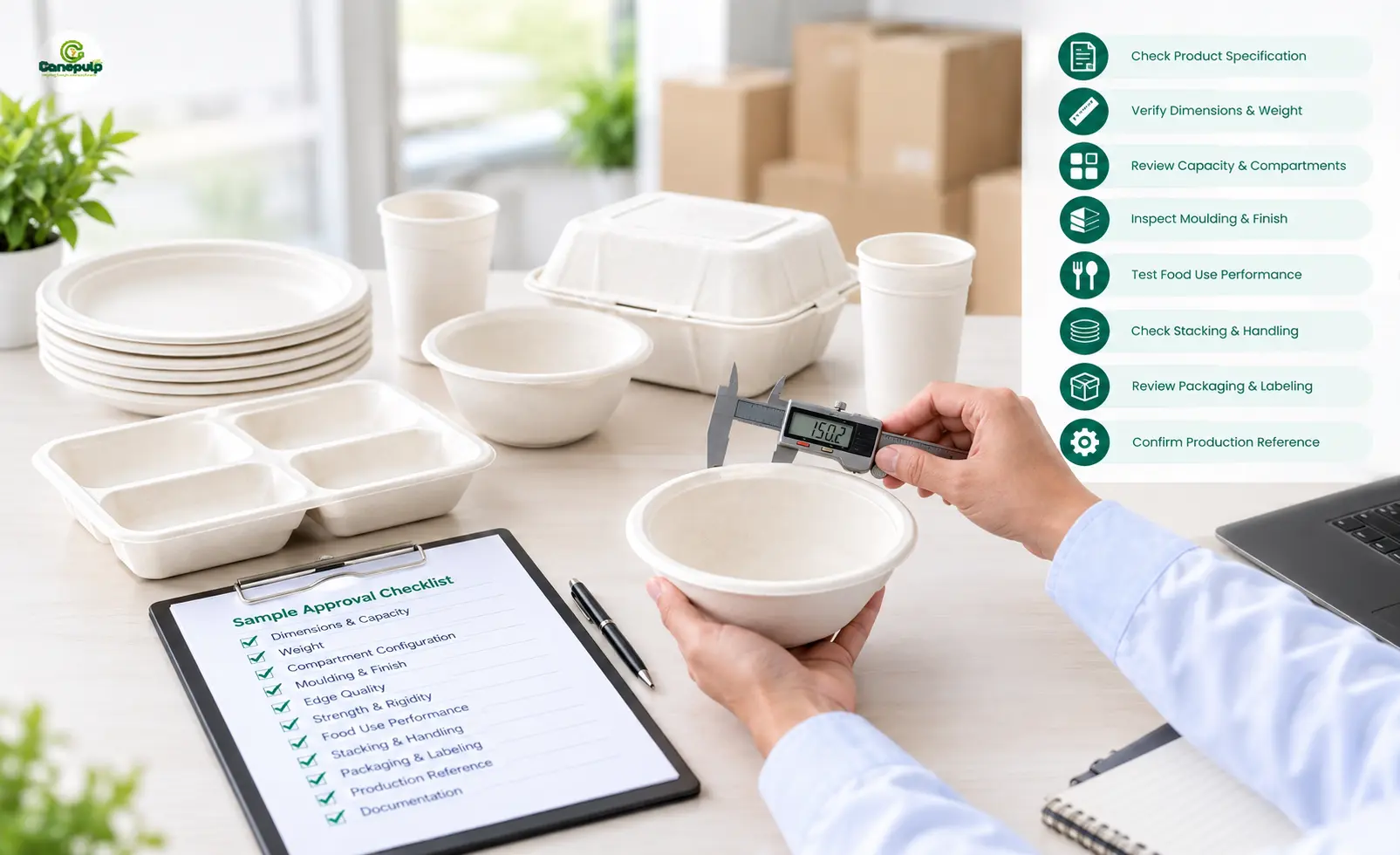
A sample can look acceptable at first glance and still leave important questions unanswered before a bulk order is finalized. For a procurement team, the real issue is not simply whether the sample looks good, but whether it matches the agreed specification and will perform consistently in the operating environment it is meant to serve. The approved sample is the reference document that links the buyer’s requirements to the supplier’s production process. If that link is weak, a bulk order becomes a much bigger commercial risk than it needs to be.
1. Confirm the Sample Matches the Quoted Specification
The first step in sample approval is to compare the sample against the exact buyer requirement. That means checking the product type, dimensions, depth, usable capacity, compartment configuration, weight, and product specification attached to the order. A buyer should not approve a sample simply because it looks similar to a product photograph or a reference item. The sample must be linked to a written specification that describes what the production batch is expected to match.
A sample that is approved without a written specification can create confusion later. If the sample differs in weight, usable capacity, edge finish, or product structure from the bulk production run, the buyer is left with a mismatch between what was approved and what was produced. For that reason, the production reference should be defined before approval, not after a bulk order has already begun.
The comparison should include measurable or practical features: diameter or dimensions, depth where relevant, weight, product type, capacity, compartment arrangement, and any key product description that the supplier has quoted. If the manufacturer provides a tolerance or measurable guideline, that should be clearly noted. If tolerance is not defined, the buyer should at least record the approved sample and the product condition that it represents.
2. Measure Weight, Size and Capacity
A buyer can learn a lot from measuring the sample rather than relying on appearance. Two products with the same nominal size can differ in weight, usable depth, capacity, rigidity, and stacking behavior. That difference matters because the product has to perform in a foodservice environment, not just on a table or in a marketing image.
For practical review, buyers can check the actual measurements of the sample and record them in the approval file. This can include dimensions, product depth, capacity, compartment size, and any internal profile that affects use. If the product is intended for soups, rice dishes, hot meals, or oily foods, the buyer should be careful not to rely only on a nominal product description. The usable capacity and structural behavior matter more than the product name alone.
The value of this process is that it creates a reference point for later production. If a buyer records the approved sample in terms of product dimensions, weight, and packaging expectations, the supplier has a much clearer production target. That makes repeat orders far easier to manage than relying on verbal references or a product photo alone.
3. Test the Product With the Food It Will Actually Carry
The best sample review reflects the real use case. A plate or bowl may appear suitable in a static product shot, but the buyer should test it under the conditions in which it will be used. Hot food, oily food, gravy, sauces, rice-based meals, soups, stacked service, and repeated handling can all affect performance in ways that are not obvious from appearance alone.
A buyer should ask whether the sample remains stable under normal use and whether it holds shape during service, transport, and restocking. For example, a product might look acceptable but fail under pressure or repeated stacking. Another sample may have a good visual finish but not hold its intended capacity when filled with the actual food items the buyer serves. This is why product testing should match real operational conditions rather than generic visual inspection.
This section is not about making universal performance claims such as “it will never leak” or “it will always hold heavy food.” The right approach is to assess the product under the buyer’s actual menu and service conditions, then document the result. That creates a practical and defendable commercial reference for production approval.
4. Check Moulding, Edges and Finish
Visual inspection is still important, but it should be tied to practical use rather than aesthetics alone. Buyers should review the sample for uneven edges, rough surface areas, deformation, incomplete moulding, shape consistency, cracking, visible defects, or any sign of poor finish. These details can affect both the buyer’s product perception and the way the item performs during normal service.
The issue is not simply whether the sample looks polished. The buyer should decide whether the sample is suitable for repeated commercial use, easy stacking, safe handling, and consistent presentation across multiple units. A product may pass a visual check yet still have an edge or contour issue that affects comfort, stacking, or long-term handling. For a production batch, those small variations can become a meaningful quality issue.
This is also where sample review should be tied to the manufacturing quality conversation. The buyer should understand whether the sample is representative of the normal production process and whether the supplier can repeat the finish and shape across a larger production run. If the sample is highly variable, the buyer should not treat it as a stable production reference.
5. Check Stacking and Handling
Handling and storage matter for foodservice buyers, distributors, and importers. A product that looks fine on a single sample may still be difficult to stack, pack, or move when used in a warehouse or during a busy service period. This makes stacking characteristics a practical part of sample approval.
Buyers can look at stack stability, ease of separation, nesting behavior, deformation under stacking, and whether the product keeps an acceptable shape when handled multiple times. This matters for restaurants, takeaway operations, catering programs, foodservice distribution, and warehousing, where repeated handling and storage conditions can affect product usability.
A stronger sample review includes the real operational conditions the product will face after shipment. If the product will sit in a dry warehouse, then be loaded into service trays, and then stacked for transport, that sequence should influence the approval decision. This is not a theoretical point; it is a practical procurement step in ensuring that the approved sample is a usable production reference.
6. Compare Multiple Samples if the Order Is Important
For important or high-volume orders, buyers may benefit from comparing more than one sample or reviewing a second production sample before giving full approval. This is especially useful where the product is critical to the operation, where multiple SKUs are being sourced together, or where the buyer is balancing price, quality, and production reliability.
A comparison of multiple samples can help confirm whether the supplier is producing consistent results across dimensions, weight, finish, capacity, and shape. This is not a requirement for every sample review, but it can be important when the commercial risk of a quality mismatch is higher. The decision depends on order size, SKU criticality, and the buyer’s ability to absorb the consequences of a batch mismatch.
In a practical B2B process, sample comparison is a risk-management tool. It helps answer whether the product is stable enough to move forward to production and whether the supplier can maintain that standard over repeat orders. That is a very different question from simply taking a first sample and moving straight to production.
7. Define What “Sample Approved” Actually Means
A buyer should not treat “sample approved” as a vague statement. It should mean that the sample has been reviewed against a defined product specification and that the production batch is expected to match that standard. The approval should capture the product, the specification, the approved sample reference, and the commercial expectations of the order.
A realistic approval file should include the product SKU or description, dimensions, weight, usable capacity, packaging expectations, material or specification reference, and record of the approved sample. If the product is private-label or OEM-driven, artwork and packaging expectations should also be confirmed before production begins. These details give the buyer a practical reference when production starts and when repeat orders are placed later.
This is the moment when the supplier and buyer align on what the product will be, how it will be judged, and what will be accepted in production. A sample approval step is only useful when that agreement is clear and documented. Otherwise, the buyer is approving a visual impression rather than a production standard.
8. Ask How the Approved Sample Is Controlled During Production
After approval, the buyer should understand how that reference is transferred into production. The supplier should be able to explain how the approved specification is communicated to the production team, how production batches are checked against that reference, and how any deviations are handled before the final order is released.
Good B2B procurement questions include: how is the approved specification communicated to production? What happens if a production batch differs from the approved sample? Who confirms specification changes? How are revised samples handled? When the buyer is working with multiple SKUs or a commercial container order, these questions become more important because the risk of inconsistency scales with volume.
This is a buyer-driven conversation, not a generic supplier description. The aim is not to copy a quality procedure from a manufacturer page, but to confirm that the approved sample can actually be replicated under production conditions and that the supplier has a practical process for checking and controlling variation. That is the right way to move from sample approval into a larger bulk production decision.
Bulk Order Buyer Checklist
- Dimensions and capacity verified
- Weight checked against the requirement
- Compartment configuration reviewed
- Moulding and finish inspected
- Edge quality and shape checked
- Strength and rigidity reviewed for intended use
- Hot, oily or gravy performance tested where relevant
- Stacking and handling checked
- Packaging expectations reviewed
- Product specification recorded
- Approved reference documented for production
- Documentation requirements confirmed
Before Approving a Bulk Order, Confirm the Production Reference
If you are preparing to move from sample approval to bulk production, align the specification, approve the sample carefully, and confirm the production reference before the order is released. Ask for product details, sample review notes, and the commercial production standard before the final approval.
A bagasse tableware sample should not be approved on appearance alone. It should be checked against the product specification, reviewed under the buyer’s actual foodservice conditions, and treated as the production reference for the commercial order. When the sample approval process is disciplined and documented, the buyer has a much stronger foundation for bulk production, repeat orders, and a more consistent commercial supply chain.