

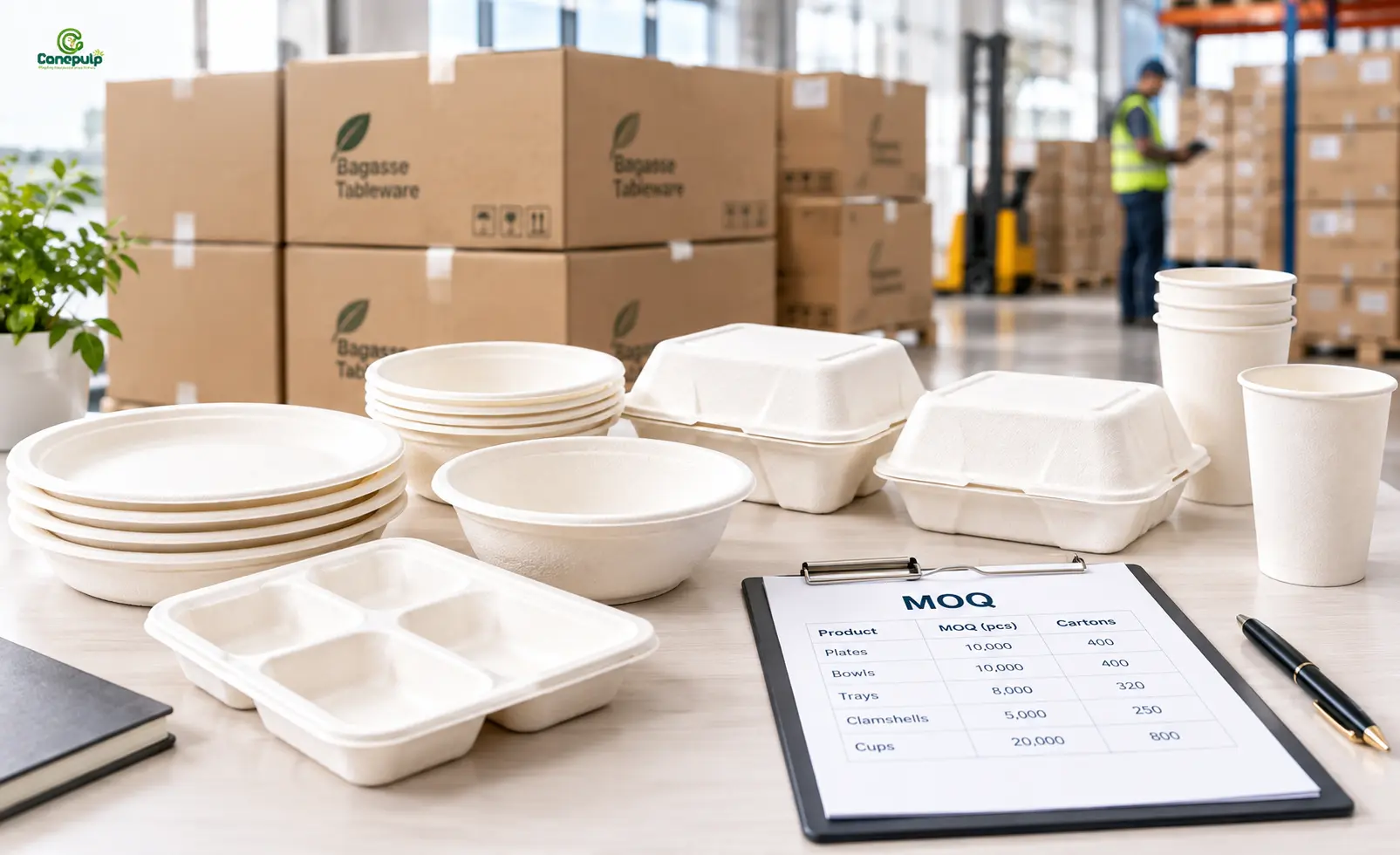
MOQ is often treated as a single number on a quotation, but in practice it is a commercial decision that reflects product type, production planning, packaging, customization, and shipment economics. For bulk bagasse tableware buyers, the real question is not only whether the MOQ is low enough. It is whether the MOQ matches the product, the production setup, the carton configuration, and the buyer’s actual order plan. A lower MOQ can look attractive on paper, but it is not automatically the better commercial option when freight, packaging, or product variation changes the economics.
1. What Does MOQ Mean for Bagasse Tableware?
MOQ stands for minimum order quantity. In B2B sourcing, it describes the smallest commercial quantity a supplier is willing to produce or ship under a given arrangement. For bagasse tableware, that quantity can be expressed in several ways: by SKU, by total order, by carton count, or by shipment volume. A buyer should be careful not to assume that every supplier uses the same model.
For example, the manufacturer might quote MOQ per SKU, per product line, or per combined order. One supplier may set a minimum based on pieces, while another may calculate it by carton count or by a total production plan. This is why buyers need to ask how the MOQ is structured before comparing offers. A headline MOQ in pieces is not always relevant if the supplier actually requires a carton-based minimum or a larger production batch to make the order commercially workable.
The most useful pricing conversations are the ones that clarify whether the MOQ is per product, per carton, or by total shipment. Without that clarity, the buyer could compare quotations that look similar but are not actually based on the same commercial assumptions.
2. Why Do Bagasse Tableware Manufacturers Set an MOQ?
The practical reason behind MOQ is production efficiency and commercial planning. A supplier has to organize raw material preparation, machine scheduling, drying, finishing, packaging, and quality checks around a production run. A small order can still require the same setup and handling effort as a larger production run, especially if it involves moulding, packaging selection, or product-specific inspection.
For molded fiber products, the production setup is often tied to product type, mould usage, and the way the line is scheduled. Different SKUs may require different moulds, tooling, or packaging setups, and a supplier has to balance that against the time required to set up and run a production run. This is one reason MOQ varies across product formats such as plates, bowls, trays, takeaway containers, and custom molded fiber products.
MOQ also reflects the cost of planning, packing, and moving the goods. It is not only about manufacturing; it is also about shipment economics and allocation of warehouse and packing resources. That is why a buyer should not view MOQ as a random administrative number. It is often a signal of how the supplier has organized its production and shipping model.
3. Does MOQ Apply Per Product or Per SKU?
This is one of the key questions for bulk buyers. A supplier can structure MOQ per SKU, per total order, or per combined shipment. In practice, a buyer should always ask how one product is treated relative to another. For example, a 9-inch plate, a 10-inch plate, a compartment tray, and a deep bowl may all be produced on the same manufacturing setup, but they are still separate SKUs with different production, packing, and stocking implications.
A buyer should ask whether different product styles can be combined in one order, whether different sizes are subject to separate minimums, and whether the order is calculated in pieces or cartons. If the supplier uses a mixed-SKU model, the buyer should understand the rules: what combinations are allowed, how the supplier handles product variation, and whether different SKUs are still subject to separate packaging or lead-time assumptions.
This distinction matters because it changes the way a buyer compares offers. An order that looks simple on paper can become complex if the MOQ is defined per SKU but the buyer expected a combined minimum across several products. Clarifying the MOQ model before confirming quantity is a very practical step in procurement.
4. How Product Type and Size Can Affect MOQ
MOQ often changes based on product type, mould complexity, and carton packing density. A plate, bowl, tray, or clamshell will not always have the same manufacturing or packaging setup. Product dimensions, production run efficiency, and packing configuration all influence how a supplier decides the commercial minimum for a particular item.
Larger or more specialized products can have different mould or tool requirements. Some products require more careful handling during finishing or drying, while others may be easier to pack densely. Those operational realities can affect how suppliers structure pricing and minimums. The buyer should be careful not to compare a bagasse plate MOQ to a deeper tray MOQ as if they were identical commercial products.
This is also why buyers should compare MOQ in the context of the specific SKU, not just in general terms. The best comparison is between product A and product B under the same commercial assumptions, using the same quoting basis, same carton logic, and same shipping configuration. Without that level of detail, the MOQ discussion can be misleading.
5. How Customization Can Change MOQ
Customization can change the commercial minimum in ways that are easy to miss. If a buyer requests private-label packaging, artwork approval, embossed branding, custom moulds, or special product dimensions, the supplier may need to incorporate additional setup, packaging procurement, artwork checking, or production planning into the commercial agreement. These additions often affect the minimum order or the order structure.
The buyer should ask whether the custom requirement adds tooling, packaging, approval steps, or a separate production minimum. This is especially relevant for OEM programs, private-label supply, or multi-market distribution where the product has to fit specific branding and product presentation requirements. A custom order is not simply a standard product with a different label attached.
This is a natural place to link to the relevant private-label or OEM guidance when relevant, because customization and MOQ are closely connected. The role of the blog is to explain the procurement logic, not to repeat what the commercial page already says about service offerings.
6. MOQ vs Carton Quantity: Why Buyers Should Check Both
Buyers should never compare suppliers using only the headline MOQ. They should also check the carton quantity, the number of pieces per carton, the carton dimensions, the pallet configuration, the net and gross weight, and the estimated shipment volume. A supplier may quote a lower MOQ in pieces, but the actual shipment may require a packing format that is inefficient or difficult to move through the buyer’s warehouse or destination logistics chain.
A simple example helps explain the point: a supplier may quote a minimum of 5,000 pieces, but the carton structure could be 250 pieces per carton, which means 20 cartons. If the buyer is moving through a distributor or importer network, the total pallet count, warehouse storage, and shipping configuration become part of the commercial decision. A low piece count can still create a logistical burden if the carton and shipment format are not aligned with the buyer’s operation.
For this reason, the buyer should compare MOQ and carton quantity together. The commercial minimum is only meaningful when the buyer understands how the product is packed, how many cartons that translates to, and how the shipment will be received at destination. This is a practical procurement question, not just a packaging detail.
7. MOQ vs Landed Cost: The Lowest MOQ Is Not Always the Lowest Cost
A lower MOQ can look commercially attractive, but it is only one part of the total cost. Buyers should evaluate the interaction between MOQ, unit price, carton count, freight, shipping terms, destination port charges, import duties, local handling, and warehousing. The real decision is the landed cost, not the advertised piece count.
This matters because a small initial order can be efficient for product testing, but a larger order may be more cost-effective once freight and destination handling are factored in. Similarly, a supplier may offer a lower MOQ but a less efficient carton configuration, which increases freight or handling costs. The supplier with the smallest minimum is not automatically the best logical choice for a commercial order.
The buyer’s aim is to compare offers across the same commercial framework. That means asking what the total order includes, what is excluded, how the supplier prices the quantity, and how the order fits the buyer’s replenishment plan. That is a much more useful comparison than looking at MOQ in isolation.
8. Questions to Ask a Bagasse Tableware Supplier About MOQ
When discussing MOQ with a supplier, buyers should ask specific, practical questions. A few key examples are below:
- Is the MOQ per SKU or for the total order?
- Is the MOQ quoted in pieces or cartons?
- Can different bagasse products be combined in one order?
- Does customization change the MOQ?
- Does packaging or carton configuration create a separate minimum?
- What is the production lead time at the quoted quantity?
- Can repeat orders be placed without the same minimum being re-negotiated?
- How does the MOQ affect shipment planning and container utilization?
- What happens if the buyer requires a smaller trial quantity?
- Are the MOQ and price confirmed for the exact SKU being quoted?
This list is useful because it turns a broad commercial question into a structured discussion. The buyer is not asking for one number only; they are asking how the supplier structures production and commercial minimums around the actual order. That makes the procurement decision more reliable and reduces the chance of a misunderstanding later in the process.
9. MOQ for First Orders vs Repeat Orders
A first order and a repeat order are not always structured the same way. In a first purchase, a buyer may be trying to validate the product, packaging, quality, and sourcing setup. In a repeat order, the focus shifts to specification control, consistent carton packing, predictable lead time, and continuing supply.
This distinction matters because the buyer should not only ask about the minimum for a new order. They should also ask how the supplier handles repeat orders at the same specification, same pack format, and same product standard. A supplier that agrees to a first low-volume order but cannot support a stable repeat model may create commercial friction later.
This is also where the approved sample and production reference become relevant. A repeat order should not be treated as the same as a new product conversation if the approved sample, packaging configuration, or product requirements have already been established. The buyer should preserve that reference in its commercial records so future ordering is consistent and easier to manage.
Bulk Order Buyer Checklist
- MOQ structure confirmed per SKU or total order
- Pieces vs cartons clarified
- Product type and size considered
- Customization impact understood
- Carton and pallet configuration reviewed
- Freight and landed cost considered
- Production lead time discussed
- Repeat order capability reviewed
- Packaging requirements clarified
- Supplier commercial terms confirmed
Before Accepting an MOQ, Clarify the Commercial Basis
For a bulk bagasse tableware order, ask how the MOQ is calculated, whether it applies per SKU, and how carton packing and shipment planning affect the final commercial outcome. The right MOQ discussion is about the actual order plan, not just the headline number.
MOQ is not just a supplier policy; it reflects how the supplier manages production, packaging, product variation, and shipment planning. For B2B buyers, the right approach is to compare MOQ with the real order structure, the product mix, the carton configuration, and the landed cost. That gives the buyer a more accurate view of the commercial decision than a single minimum number on a quotation.