

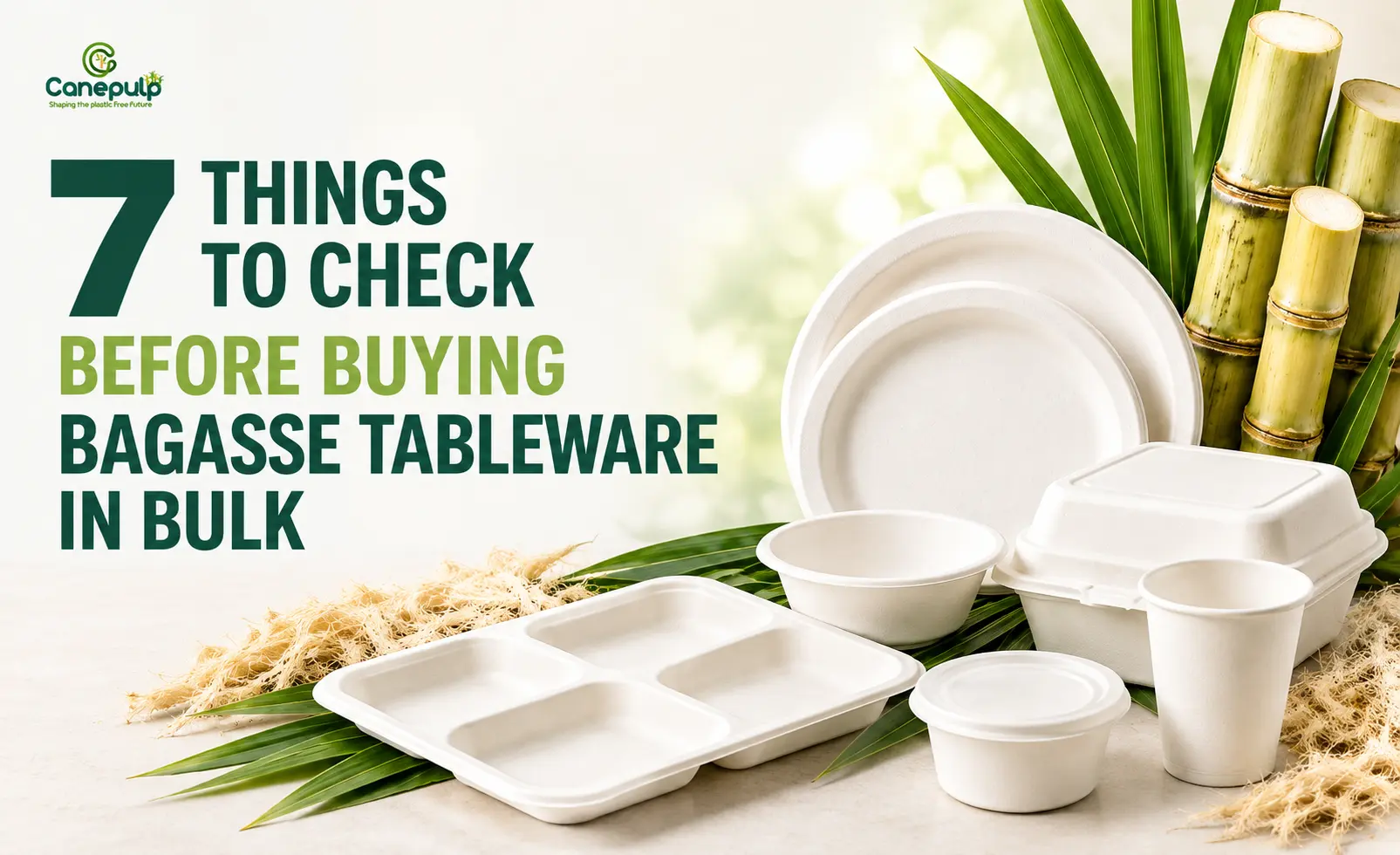
Buying bagasse tableware in bulk is a specification and supply-planning decision, not simply a larger retail purchase. Before comparing quotations, a procurement team should define the required product, intended food use, shipment format, documentation, and replenishment schedule. Dimensions, weight, usable capacity, food-contact information, carton packing, MOQ, lead time, and repeat-batch control all affect the real cost and operational risk of the order. The approved sample and written specification should be the reference for every later shipment.
1. Check the Actual Product Specifications
Request the exact diameter or dimensions, depth where applicable, weight, usable capacity, compartment configuration, material, thickness or strength information where measurable, and acceptable production tolerance. Record these details for every SKU, including bulk bagasse plates, bulk bagasse bowls, trays, clamshells, and containers. A stated size alone is not enough for a foodservice purchasing decision.
Compare the specification sheet and an approved sample, not only product photographs. Two products with the same stated size can perform differently if their weight, construction, usable capacity, or manufacturing consistency differs. Confirm how the approved sample should be checked against the production batch, including fit with lids, stacking, handling, and the hot, oily, or gravy-based foods in the intended menu.
Before approval, ask how changes to moulds, material preparation, weight, or dimensions are communicated. A short written specification with sample reference, tolerance, and acceptance criteria reduces ambiguity when the order is repeated.
2. Check the Manufacturer's Production Capability
Confirm where the products are manufactured, what production setup is disclosed, how sampling moves into production, and what lead-time assumptions apply to your SKU mix. Ask whether the quoted availability is finished stock, scheduled production, or an estimate based on current capacity. These are different supply situations and should not be treated as interchangeable.
For a recurring program, ask how an approved specification is released to production, how repeat batches are checked, how changes are controlled, and what happens when a mould, material, or packing method changes. Review Canepulp's manufacturing process and manufacturer profile as background, then request the current lead time and production plan for the actual SKUs.
3. Check MOQ, Carton Packing and Pallet or Container Planning
MOQ should be checked per SKU, not only per purchase order. Confirm pieces per carton, carton dimensions, gross and net weight, pallet configuration where applicable, and whether the quoted carton count is based on the approved product. For wholesale bagasse tableware, these details affect warehouse space, pick-and-pack work, freight class, and the number of saleable units received.
Ask whether mixed-SKU shipments are available and whether LCL or FCL is appropriate for the order volume, destination, and replenishment schedule. Compare the full landed calculation: product value, cartons, pallets, freight, port charges, duties where applicable, handling, and expected wastage. MOQ alone does not determine the most economical order size.
Confirm how cartons protect the products from compression, moisture, and handling damage in transit. Before shipment, require the packing list and confirmed quotation for the actual SKUs, including carton count, weights, dimensions, shipping terms, and any container-utilization assumptions.
4. Check Quality Control and Batch Consistency
Ask what is inspected, when inspection happens, and which records are kept. The discussion should cover dimensional consistency, moulding quality, smooth edges and finish, strength, visible defects, moisture and storage conditions, and the difference between an approved sample and a production batch. Where performance matters, agree on practical sample tests for stacking, handling, and the foods the product will carry, including hot or oily menu items.
Define acceptance criteria before production starts: which dimensions have tolerance, what counts as a visible defect, how many units are sampled, and how non-conforming cartons are isolated or corrected. Review Canepulp's quality control page as background, then request the inspection and release process for the quoted order rather than relying on a general quality statement.
5. Check Food-Contact and Certification Documentation
Documentation depends on the destination market, intended food use, product or SKU, and the buyer's importer requirements. Depending on the order, request food-contact documentation where applicable, product test reports, quality-management certifications, environmental certifications, manufacturing or GMP documentation where applicable, and destination-market labelling information.
Use the certifications page as a starting point, then request the actual current documents covering the quoted SKU and market. Check document scope, issue date, product description, test method, and issuing organization. Do not assume FDA, EU, UK, or any other market compliance without current documentation that supports the specific product and intended use.
6. Check Whether the Supplier Can Support Your Market
Check whether the supplier can support the requirements of your destination country and route: export documentation, port requirements, carton and label requirements, importer information, shipping terms, and recurring shipment schedules. Confirm who prepares each document and which details must match the commercial invoice, packing list, and transport documents.
Use Canepulp's export markets resources as a starting point, then verify the requirements for your own destination. For private label or OEM work, agree on artwork, packaging specifications, tooling, order quantity, sample approval, and change control before treating the project as ready for production.
7. Check the Supplier's Long-Term Supply Reliability
Evaluate the supplier's ability to repeat the approved specification, communicate lead times, maintain packaging consistency, prepare documents, respond to exceptions, and support replenishment. It may also be commercially useful to source plates, bowls, trays, containers, cups, and related formats through one supplier, but compare each SKU on its own specification and packing requirements.
Before committing to a recurring program, ask who owns the approved specification, how revisions are recorded, how production updates are shared, how shortages or delays are escalated, and what information accompanies each shipment. For private-label or OEM projects, review the private-label manufacturing service before finalizing artwork or packaging commitments. A supplier should be evaluated on a documented process, not only on a successful sample order.
Bulk Order Buyer Checklist
- Product dimensions
- Product weight and specification
- Capacity and compartments
- MOQ
- Pieces per carton
- Carton dimensions and weight
- Sample performance with intended food types
- Transit protection and export packing
- Quality-control process
- Relevant certificates and documents
- Production lead time
- Export documentation
- Shipping terms
- Sample approval
- Repeat-order capability
Need a Bulk Bagasse Tableware Supplier?
Request product specifications, MOQ, bulk pricing, export packing details, OEM or private-label options, and sample requirements from the Canepulp team.
A disciplined bulk biodegradable tableware purchase starts with a written specification, an approved sample, clear packing information, defined acceptance criteria, and documents that match the destination market. Confirm those items before placing the order, then keep the approved specification, quotation, packing list, and inspection records as the reference for repeat shipments.