

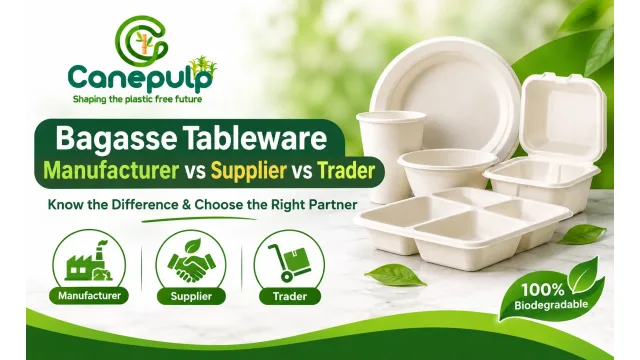
When sourcing bagasse tableware, buyers often see the terms manufacturer, supplier, exporter and trader used interchangeably. These terms can describe different operating models. A manufacturer may control molding and production at its own facility. A supplier may manufacture products directly or source them from manufacturing partners. An exporter or trader may coordinate products, documentation and logistics without controlling the production process. For an importer, distributor, wholesaler, foodservice company or private-label brand, understanding that difference can help with specification control, quality verification, documentation, customization, traceability and repeat-order planning. The most useful question is therefore not simply “Who calls themselves a manufacturer?” but “Who controls the product I am buying, and what can they demonstrate?”
Manufacturer vs Supplier vs Trader: What Is the Difference?
The three terms describe different aspects of a B2B sourcing relationship. A manufacturer is primarily defined by production control. A supplier is defined by its role in providing products to the buyer. A trader generally buys and resells products made by another business. In practice, one company can perform more than one role.
For bagasse tableware buyers, this distinction matters because production control can affect product development, custom moulds, specifications, quality checks, documentation and repeat orders. A buyer should therefore verify the actual operating model for the specific SKU instead of relying only on terminology used on a website or quotation.
A manufacturer may sell directly to overseas buyers. A supplier may have its own factory or maintain relationships with multiple factories. A trader may provide commercial and logistics support while depending on third-party manufacturers. None of these labels alone establishes product quality or suitability. The buyer should evaluate the evidence behind the quoted product and the company's responsibilities throughout the order.
What Is a Bagasse Tableware Manufacturer?
A bagasse tableware manufacturer controls all or a defined part of the process used to convert sugarcane bagasse fiber into molded-fiber tableware or food packaging. Depending on the facility, production may include raw-material handling, pulp preparation, forming, molding, drying, hot pressing, finishing, inspection and packing.
For B2B buyers, the important issue is not whether every production stage happens under one roof. The important issue is whether the company can clearly explain which stages it controls, where the product is made, how specifications are maintained and how quality is checked.
Manufacturing capability can also include product development and custom tooling. A buyer requesting a different compartment layout, diameter, depth, edge profile, weight or capacity may need direct technical support. Custom mould development normally requires design review, tooling decisions, sample approval and a defined production process.
Useful questions include: Which products are manufactured at your facility? Who controls the mould? Where are quality checks performed? How is the approved sample converted into a production specification? How are changes recorded? These questions can help an importer evaluate whether a claimed bagasse tableware manufacturer India can actually support the required program.
For a broader overview of production capability, buyers can also review the Canepulp manufacturing process before discussing a specific product or project.
What Is a Bagasse Tableware Supplier?
A supplier is a company that provides products to a buyer. A bagasse tableware supplier may manufacture products directly, purchase products from manufacturing partners, maintain inventory, coordinate production, manage packaging or combine several of these functions.
The word supplier therefore describes the commercial relationship more than the manufacturing method. A supplier can be a factory, export company, distributor, sourcing company or trading business.
The supplier model can be useful when a buyer needs a broad product range, consolidated purchasing, export coordination or access to products from several manufacturing facilities. The buyer should still establish where each SKU is manufactured and who controls the product specification and quality documentation.
Before choosing a wholesale bagasse tableware supplier, ask whether the quoted product is manufactured in-house or sourced from a partner. Also ask whether repeat orders will come from the same production source, who approves samples, how changes are communicated and which company is responsible for the relevant documents.
A transparent supplier should be able to explain its role clearly without creating confusion about the actual manufacturing source.
What Is a Bagasse Tableware Trader or Reseller?
A trader or reseller generally purchases products made by another company and sells them to customers. Trading businesses can add value by finding products, consolidating orders, negotiating commercial terms, coordinating export paperwork and managing communication between buyers and manufacturing partners.
This model can work well for standard products where the buyer mainly needs product availability, commercial coordination or consolidated sourcing. However, the buyer should understand how production information is transferred between the trader and the actual factory.
A trader may not directly control pulp preparation, molding, production scheduling, batch inspection or technical changes. If a buyer requires exact product weight, repeatable dimensions, custom moulds, private-label packaging or long-term specification control, those responsibilities should be clearly defined before the order.
A trader is therefore not automatically unsuitable. The appropriate model depends on the buyer's requirements. The key is to identify the actual manufacturer, responsibilities and documentation chain for the product being purchased.
Manufacturer vs Supplier vs Trader: Key Differences
The following comparison is a practical starting point rather than a ranking. A supplier may have strong manufacturing control, while a manufacturer may use export partners. Buyers should verify the specific arrangement for the exact product and order.
| Buyer consideration | Manufacturer | Supplier | Trader |
|---|---|---|---|
| Primary role | Controls all or part of production | Provides products and may manufacture or source them | Usually purchases and resells products |
| Manufacturing control | Direct control over defined production stages | May be direct or through manufacturing partners | Usually depends on third-party factories |
| Product customization | Can often discuss requirements directly with technical teams | Depends on the production source | Usually depends on the factory |
| Custom moulds | Can discuss technical feasibility directly | May coordinate mould development | Usually coordinates through a manufacturer |
| Quality-control visibility | Can explain production and inspection procedures | Depends on the source and supplier controls | May have limited production visibility |
| Batch consistency | Can connect production to internal records | Depends on manufacturing-source control | Depends on third-party production |
| Traceability | Usually closer to production records | Requires clear source and order records | May involve multiple parties |
| MOQ | Depends on production capacity and planning | May offer broader sourcing flexibility | May offer standard-item flexibility |
| OEM / private label | Can discuss production and packaging requirements | May coordinate the complete project | May coordinate through a manufacturing partner |
| Product development | Direct technical feedback may be available | May coordinate technical feedback | Usually depends on the factory |
| Documentation | Can provide relevant production documentation where available | Should match documents to the applicable product and source | Should identify the original product and document issuer |
| Pricing | May reflect manufacturing and export costs | May include sourcing and service costs | Usually includes resale margin |
| Long-term supply | Can be connected directly to production planning | Depends on source stability and supplier controls | Depends on continued access to the manufacturing source |
Which Model Fits Your B2B Buying Requirement?
There is no single sourcing model that fits every buyer. The appropriate arrangement depends on volume, customization, product range, documentation requirements, destination market and the level of production control required.
- Container-scale importer: Consider a manufacturer or a supplier that can demonstrate stable production control, approved specifications, packing information and export documentation.
- Distributor or wholesaler: Look for a partner that can maintain repeat SKUs, communicate specification changes and support predictable replenishment.
- Foodservice buyer: A manufacturer, supplier or trader may work for standard products when samples, specifications, food-use requirements and availability are clearly established.
- Retail brand: Verify product specifications, packaging, artwork, carton information and documentation before placing a recurring order.
- Private-label brand: Look for an OEM bagasse tableware manufacturer or supplier that can demonstrate control over product approval, artwork, packaging and production.
- Custom-product buyer: Ask for technical review, product drawings or specifications, mould-development information and samples before bulk production.
- Buyer requiring compliance documents: Request current documents relevant to the exact product and intended application rather than relying only on a general certification statement.
- Buyer requiring repeat consistency: Ask how weight, dimensions, capacity, packing and approved specifications are recorded and controlled between orders.
How to Verify a Bagasse Tableware Manufacturer in India
When comparing a bagasse tableware manufacturer India, website claims should be treated as a starting point rather than the complete verification process. A B2B buyer can ask for evidence covering the actual product, production process, quality system and commercial documentation.
Start by identifying which products are made at the facility. Then ask how the product moves from raw material to molded article and where inspection takes place. If the buyer requires custom products, ask who handles mould development and how the approved design is transferred into production.
For recurring orders, ask how specifications are retained. Useful information can include product weight, dimensions, capacity, material description, carton quantity, packing configuration and approved sample references.
Documentation should also be checked carefully. Certificates, test reports and other compliance documents should be relevant to the product and intended use. The company name, document issuer, scope, dates and applicable product information should be reviewed rather than relying only on a certificate logo.
For buyers evaluating manufacturing capability, the bagasse tableware manufacturer India page provides additional information about Canepulp's manufacturing positioning and B2B supply capabilities.
What Should Buyers Check Before a Bulk Bagasse Tableware Order?
Before releasing a container-scale or recurring order, convert the agreed product into a controlled order specification. Confirm the approved sample and make sure the quoted dimensions, weight, capacity, shape and intended use match the product being supplied.
Packaging information should also be confirmed. This may include pieces per carton, carton dimensions, gross and net weight, palletization, carton marks, loading requirements and artwork where applicable.
For international orders, confirm the agreed Incoterm, production lead time, shipping documentation and destination requirements. Where certificates or test reports are required, confirm that the documents relate to the applicable product and intended use.
For a detailed quality review, buyers can read how to evaluate bagasse tableware quality before a container order. For repeat-order controls, see the approved-sample specification-control guide.
Product Specifications Matter More Than a Supplier Label
A buyer can compare two companies using the same “manufacturer” or “supplier” label and still receive very different levels of technical information. For bagasse tableware, the product specification should be clear enough for the buyer to understand exactly what has been quoted.
Depending on the product, useful specifications can include dimensions, weight, capacity, compartment configuration, shape, material description, colour or finish, packing quantity and intended food application.
For repeat orders, the approved specification becomes especially important. If a product is purchased regularly, the buyer should understand how the supplier records the approved sample and how changes are communicated before production.
This is particularly relevant for private-label and wholesale programs where one product may be distributed through multiple customers or markets.
OEM and Private-Label Bagasse Tableware: What to Verify
OEM and private-label programs require more coordination than simply purchasing standard catalogue products. The buyer may need custom dimensions, mould development, packaging artwork, carton specifications, labels, samples and production approvals.
Before starting an OEM project, confirm who is responsible for the mould, who approves technical drawings, who owns or controls the tooling, how samples are approved and how the final production specification is recorded.
Packaging should be treated as part of the same controlled process. Confirm artwork approval, carton information, product identification and the point at which production can begin.
For private-label bagasse tableware, the most useful supplier is the one that can clearly explain the complete workflow from product brief to approved sample and production.
Certificates, Test Reports and Documentation: What Buyers Should Verify
Certificates and test reports can provide useful evidence, but buyers should examine what each document actually covers. A certification logo alone does not necessarily establish that a particular product meets every requirement of a destination market.
Before a bulk order, ask for current documents relevant to the exact product and intended application. Check the issuing organization, company name, dates, scope and any product or testing information provided.
Depending on the destination and buyer requirements, documentation may include management-system certificates, product test reports, food-contact information, declarations or other export-related documents. The applicable requirements should be confirmed for the specific market and product.
Canepulp provides a dedicated certifications and documentation page where buyers can review the company's available certification information.
Bagasse Tableware Supplier India: Questions International Buyers Should Ask
International buyers sourcing from India often need more than a product quotation. They may also need export coordination, product documentation, packing information, production planning and communication across the order lifecycle.
Before selecting a bagasse tableware supplier India, ask where the product is manufactured, what production capacity is available, how samples are approved, how repeat orders are controlled and which documents can be supplied for the relevant products.
For container orders, also confirm carton dimensions, loading information, lead time, shipping terms and the commercial documents required for the shipment.
Buyers should compare suppliers using the complete sourcing requirement rather than comparing unit price alone.
Bagasse Tableware Exporter India: What International Buyers Should Verify
A bagasse tableware exporter India may coordinate manufacturing, documentation, packing and international shipping. Buyers should establish whether the exporter is also the manufacturer or whether production is performed by a separate factory.
This distinction is particularly important when the buyer needs repeat orders, custom moulds, private-label packaging or detailed product documentation. The buyer should know which company controls the product and which company is responsible for export coordination.
Before shipment, confirm the commercial invoice, packing list, certificate of origin or other documents where applicable, along with product-specific documentation requested by the destination buyer or market.
Clear responsibility between manufacturer, exporter and buyer can reduce confusion during production and shipment preparation.
10 Questions to Ask Before Choosing a Bagasse Tableware Supplier
Ask these questions before comparing quotations. The answers can help establish whether you are dealing directly with a manufacturer, a controlled supplier or a trading partner.
- Are you the actual manufacturer of the quoted product?
- Where is the product manufactured?
- Which production stages are controlled by your company?
- Can you provide product dimensions, weight, capacity and material specifications?
- Can you provide current certificates or test reports relevant to the product?
- Can you provide samples before bulk production?
- How is the approved sample transferred into the production specification?
- Can you develop custom moulds or custom product dimensions?
- What is the MOQ and expected production lead time?
- How do you maintain consistency between repeat orders?
Why Manufacturing Transparency Matters in B2B Bagasse Tableware
Manufacturing transparency gives a buyer a clearer view of how a bulk order will be produced and controlled. If a company can explain where the product is made, how specifications are recorded and who performs quality checks, the buyer has more information for evaluating the supply arrangement.
Transparency is especially relevant when the buyer needs customization. A private-label project may involve product design, mould development, artwork, packaging and production approvals. These activities require communication between commercial and technical teams.
For recurring B2B supply, transparency can also help clarify responsibility when specifications change, new packaging is introduced or a repeat order is placed.
The objective is not simply to find a company using the word “manufacturer”. It is to understand the actual production and supply chain behind the product.
Manufacturer, Supplier or Trader: A Practical Decision Framework
Use this framework when reviewing a shortlist of potential bagasse tableware partners:
- If you need standard SKUs for an initial order: A supplier or trader may be suitable if samples, specifications, documentation and availability are clear.
- If you need container-scale repeat orders: Evaluate production control, specification retention, packing consistency and repeat-order planning.
- If you need private label: Verify product approval, artwork, packaging approval and production release procedures.
- If you need custom moulds: Verify technical responsibility, tooling control, design approval and production feasibility.
- If you need compliance documentation: Ask for documents relevant to the exact product and intended application.
- If you need multiple product categories: Confirm the manufacturer and specification for each SKU rather than assuming all products come from one factory.
Frequently Asked Questions
What is the difference between a bagasse tableware manufacturer and supplier? A manufacturer controls all or part of production, while a supplier is the business providing the product and may manufacture it directly or source it from another factory.
Is a bagasse trader the same as a manufacturer? No. A trader generally sells products manufactured by another business. The buyer should identify the actual production source and understand how quality, specifications and documentation are controlled.
How can I verify whether a bagasse company is a manufacturer? Ask where the product is made, which production stages are controlled, where quality checks occur, who controls the mould and how the approved product specification is maintained.
Should importers buy directly from a manufacturer? Direct manufacturing can provide direct access to production information, but a capable supplier or export partner may also be appropriate when responsibilities and production control are clearly documented.
Can a supplier provide custom bagasse tableware? Yes. A supplier may develop custom products through its own facility or a manufacturing partner. Confirm who handles technical development, tooling, samples and production approval.
What documents should I request before a bulk bagasse tableware order? Depending on the product and destination, buyers may request product specifications, relevant certificates or test reports, food-contact information, packing details and export documentation.
What specifications should I confirm before ordering bagasse tableware? Depending on the SKU, confirm dimensions, weight, capacity, shape, compartment configuration, material information, packing quantity and any agreed tolerance or quality requirements.
How can I check product quality before a container order? Approve a representative sample, compare it with the written specification, confirm intended use and establish how the approved sample will be controlled during bulk production.
What should a private-label buyer verify? Confirm product specifications, mould responsibility, sample approval, artwork, packaging, carton information, production release and documentation before bulk production.
Is the lowest price always the best sourcing option? Unit price is only one part of a B2B sourcing decision. Buyers should also consider specifications, quality control, documentation, packing, lead time, customization and repeat-order requirements.
Why Canepulp for B2B Buyers?
Canepulp presents molded-fiber tableware and food-packaging products for B2B buyers evaluating product specifications, manufacturing capabilities, quality practices and export requirements.
Buyers can compare the bagasse plate range, review wholesale supply options, the manufacturing process, sustainability practices and certifications and documentation before discussing a product requirement.
For buyers looking for standard bagasse tableware, bulk supply, OEM projects or private-label requirements, the appropriate scope depends on the SKU, quantity, destination, packaging requirements and technical specifications.
For company background, buyers can visit About Canepulp, review bulk order planning or send a product requirement through the quote form.
Bulk Order Buyer Checklist
- Supplier or manufacturer identity verified
- Actual manufacturing location confirmed
- Product specification and intended use confirmed
- Dimensions, weight and capacity confirmed
- Sample approved before bulk production
- Custom mould responsibility confirmed where applicable
- Relevant certificates and test reports reviewed
- MOQ and production lead time confirmed
- Carton quantity, dimensions and weights confirmed
- Private-label artwork and packaging requirements approved
- Export documents and shipping terms confirmed
- Repeat-order and specification-control process discussed
Need a Transparent B2B Bagasse Tableware Partner?
Looking for a bagasse tableware manufacturing partner for bulk orders, OEM or private-label production? Explore Canepulp's products and manufacturing capabilities or contact the team with your product requirements.
Choosing between a bagasse tableware manufacturer, supplier and trader is a practical sourcing decision based on production control, product requirements and the buyer's supply program. Instead of relying only on a company label, verify the actual manufacturing source, product specifications, sample approval process, quality controls, documentation, customization capability, packing information and repeat-order process. For importers, distributors, wholesalers, foodservice companies and private-label brands, a clear understanding of these factors provides a stronger basis for evaluating a B2B bagasse tableware supply relationship.