

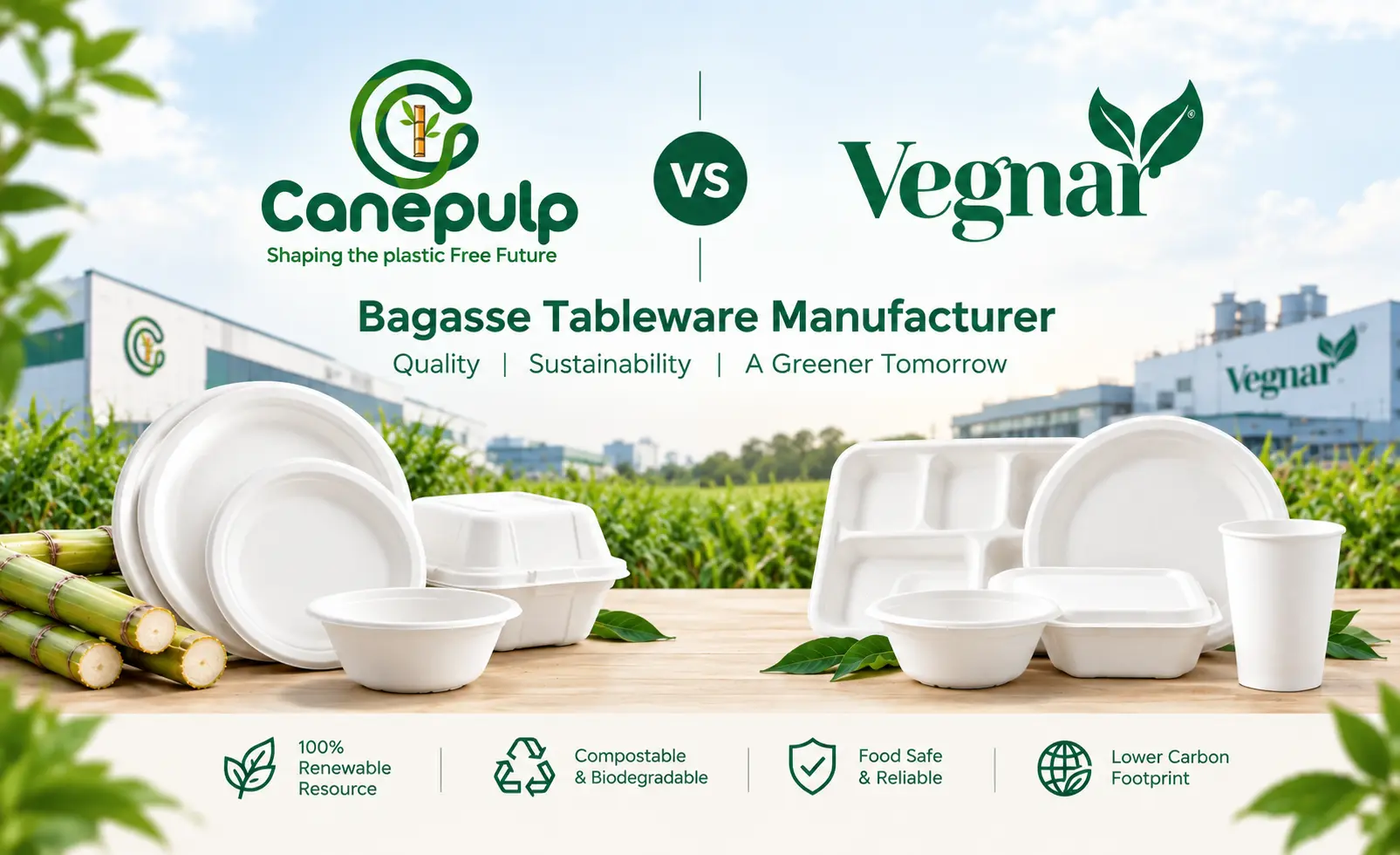
If you search for bagasse tableware manufacturers in India, Canepulp and Vegnar can look surprisingly similar at first glance. Both operate in Gujarat. Both manufacture sugarcane bagasse tableware. Both target B2B customers. Both offer products such as plates, bowls, trays and food containers. Both talk about quality, certifications, export supply and customization. So if you are an importer, distributor, wholesaler, foodservice buyer or private-label brand, the obvious question is: which one should you choose? The problem is that a manufacturer comparison based only on website appearance can become misleading very quickly.
1. Canepulp vs Vegnar: The Comparison Looks Simple Until You Start Buying
Imagine that you are a distributor in the United States, United Kingdom, Europe, Australia or another international market. You need several bagasse tableware SKUs for your customers and you want to source directly from India.
You visit the websites of Canepulp and Vegnar.
You see plates. Bowls. Containers. Trays. Clamshells. Export information. Certifications. Sustainability messaging. Customization options.
At this stage, it is tempting to say that the two suppliers are essentially offering the same thing.
But B2B procurement does not end with product discovery.
You still have to answer questions such as: What exact weight do I need? Which dimensions? What tolerance is acceptable? How many pieces fit in a carton? What is the MOQ? What is the actual production schedule? Which documents apply to my destination market? Can the manufacturer repeat the same specification six months later? What happens if my demand suddenly increases? Can the packaging carry my brand? Who controls the tooling? How is quality checked before dispatch?
That is where a meaningful manufacturer comparison begins.
2. Who Are Canepulp and Vegnar?
Canepulp presents itself as an India-based sugarcane bagasse tableware and molded-fiber manufacturer serving distributors, importers, wholesalers, foodservice businesses and private-label buyers. Its manufacturing operation is presented in Ahmedabad, Gujarat, with factory-direct B2B and export supply. The company publicly lists approximately 125 tons per month of production capacity and 10 production machines.
Vegnar presents itself as a Gujarat-based bagasse manufacturer and exporter serving domestic and international markets. Its website describes an in-house manufacturing facility, automated production lines, a broad product portfolio and international customers. Its About page states 50+ SKUs, 500,000+ pieces per day and partners in more than 15 countries.
Both companies therefore have a clear manufacturing and B2B orientation. The important difference for a buyer is not simply where the companies position themselves, but how their capabilities match the specific purchasing requirement.
3. The First Major Difference: How Each Company Communicates Its Manufacturing Capability
Canepulp places significant emphasis on the manufacturing workflow itself. Its manufacturing information describes raw-material inspection, pulp preparation, precision molding and heat pressing, quality inspection, finishing, export packing and shipment preparation.
The company also identifies its manufacturing location, production machines and monthly production capacity as specific factory information rather than communicating only a general “large-scale manufacturing” message.
Vegnar places stronger emphasis on facility scale, automation and production output. Its manufacturing page highlights a 50,000+ square-foot facility, advanced machinery, automated production lines and a stated capacity of 5M+ units per month. Its About page separately states production capacity exceeding 500,000 pieces per day.
Neither communication style is automatically better.
For one buyer, factory process visibility may be more important. For another, production scale may be the first consideration.
The smarter approach is to ask: which information helps me assess the risk of my own order?
4. 125 Tons per Month vs Millions of Pieces: Can You Really Compare the Numbers?
This is one of the most interesting parts of the comparison.
Canepulp publicly communicates production capacity primarily in weight: approximately 125 tons per month.
Vegnar communicates production capacity in pieces, with its manufacturing page stating 5M+ units per month and its About page stating more than 500,000 pieces per day.
At first, these numbers appear easy to compare. They are not.
A plate may weigh significantly less than a heavy clamshell. A shallow tray may use less material than a deep container. A multi-compartment meal tray may require a different production cycle from a simple round plate.
Therefore, tons and pieces are different ways of measuring output.
For a buyer, the useful question is not “Who has the bigger number?”
The useful question is:
“How many pieces of my exact SKU can you manufacture during the production window I need?”
That question removes much of the confusion created by different capacity measurements.
5. There Is Another Capacity Question Buyers Often Forget
Suppose a manufacturer tells you that its factory can produce millions of pieces per month.
That sounds reassuring. But what matters to your business is not theoretical factory output. It is production availability when your purchase order is scheduled.
Factories have existing customers. Machines may already be allocated. Some SKUs may require particular tooling. Seasonal demand can change production schedules. Packaging requirements can add additional time.
A buyer placing a recurring order should therefore ask for three different things:
1. Total manufacturing capacity.
2. Capacity of the relevant product category or SKU.
3. Available production capacity during the required order window.
This is a much stronger way to compare Canepulp and Vegnar than simply comparing the largest capacity number displayed on either website.
6. Product Range: Does 50+ SKUs Automatically Mean More Value?
Vegnar publicly presents 50+ SKUs across categories including plates, bowls, clamshells, cups, trays and custom designs.
Canepulp presents a product portfolio covering plates, bowls, food containers, clamshell boxes, meal trays, cups and other molded-fiber formats.
For distributors, a broad catalog can be extremely useful. One manufacturer may be able to supply several categories, reducing the number of factories the buyer needs to coordinate.
But product count should not be confused with manufacturing suitability.
Imagine that your business sells one specific 9-inch compartment plate. You do not need 50 SKUs. You need one SKU produced consistently, packed correctly and delivered on time.
On the other hand, if you are building a complete foodservice range, a broad product portfolio can become a major advantage.
So the better question is not “Who has more products?”
It is:
“Which manufacturer has the right products for my sales strategy, and can they maintain those products consistently?”
7. If You Are a Distributor, Product Breadth Can Change the Decision
A distributor often has a different problem from a private-label brand.
A distributor may want plates, bowls, containers, clamshells and trays from one manufacturing partner. Consolidating several SKUs with one supplier can simplify communication, purchasing, documentation and shipment planning.
In that situation, the breadth of both Canepulp and Vegnar should be evaluated SKU by SKU.
Do not simply count product pages.
Create a real sourcing list. For example: 6-inch plate, 9-inch 3-compartment plate, 12-inch 4-compartment tray, 24-ounce bowl, 9x9 clamshell and selected food containers.
Then ask each manufacturer which exact products are available, their current specifications, weights, packaging, MOQ and production lead time.
That exercise will tell you much more than the number of products shown in a website navigation menu.
8. If You Are a Private-Label Brand, the Comparison Changes Completely
Private-label buyers have a different set of priorities.
The product itself is only one part of the project. The packaging, artwork, barcode, retail presentation, carton configuration, inserts and branding all become part of the manufacturing relationship.
Canepulp publicly presents private-label manufacturing with logo applications, retail sleeves, multilingual inserts and barcode-ready cartons. Its private-label information also describes integrated pulping, molding, thermoforming, quality inspection and export-grade packing.
Vegnar also publicly offers custom branding, custom packaging and custom product solutions, including distribution and OEM-oriented programs.
For both companies, the important questions are deeper than “Do you offer private label?”
A buyer should ask:
Who owns the mold?
Who approves the artwork?
What is the packaging MOQ?
Can different SKUs use one private-label packaging system?
How are barcode and regulatory requirements handled?
What happens when packaging artwork changes?
How are repeat orders matched to the original approved specification?
9. Manufacturing Process: Where Does the Fiber Become the Product?
Bagasse tableware is not simply sugarcane waste placed into a mold.
The production process affects fiber quality, pulp consistency, product geometry, wall thickness, surface finish, drying, strength and repeatability.
Canepulp describes a five-stage manufacturing workflow covering raw-material inspection, pulp preparation, precision molding and heat pressing, quality inspection and finishing, followed by export-ready packing.
The company specifically identifies checks for moisture, fiber quality, pulp consistency, dimensional accuracy, weight, surface finish, edge quality and structural strength.
Vegnar describes a multi-stage manufacturing process involving bagasse processing, pulp formation, molding, drying, inspection and packaging. Its published manufacturing content emphasizes automated production and quality-control procedures, including dimensional checks, visual inspection, weight verification and product testing.
For a buyer, the important point is that both companies describe controlled manufacturing rather than treating bagasse tableware as a simple commodity product.
The next question is how those controls are applied to your specific SKU.
10. The Sample Is Good. But Can the Factory Repeat It?
This is where many first-time buyers make a mistake.
A sample arrives. It looks clean. The plate is white. The edges look good. The product feels strong. The buyer approves it.
Then the bulk order begins.
The real manufacturing test is not whether one sample is good. It is whether the commercial batch continues to match the approved specification.
That means weight, dimensions, shape, surface finish, rigidity, stacking behavior, packaging and other agreed characteristics need to remain within the defined tolerance.
Canepulp's current buyer-focused quality content places significant emphasis on approved reference samples, written specifications, batch consistency and repeat-order control.
Vegnar also publicly describes production-batch quality checks including dimensional checking, visual inspection, weight verification, leak testing for relevant products and periodic laboratory testing.
This is an area where buyers should evaluate both companies using exactly the same questions instead of assuming that one website automatically proves better quality.
11. Weight: A Small Number That Can Become a Big Commercial Issue
When buyers compare two bagasse plates, they often compare diameter first.
But diameter is only one part of the specification.
Weight can affect material usage, rigidity, product feel, stacking, freight weight and the commercial economics of the order.
A heavier product is not automatically better. The target should depend on the intended application and the approved product specification.
What matters is consistency.
If a buyer approves a product at one target weight and later receives a significantly different production output, the buyer may experience differences in strength, handling, packaging and even shipping economics.
Therefore, for both Canepulp and Vegnar, buyers should define the target product weight and acceptable tolerance before commercial production.
12. Certifications: This Is Where Buyers Need to Slow Down
Vegnar has a very visible certification presence on its website. Its public pages reference FDA approval, SGS testing, ISO 9001:2015, ISO 14001:2015 and compostability-related certifications including OKComposite and Sobar.
Canepulp publicly references ISO 9001:2015, ISO 14001:2015, GMP and product-specific testing or documentation where applicable.
At first glance, a buyer might simply count the certification badges.
That would be the wrong approach.
Different certifications answer different questions.
ISO 9001 relates to quality-management systems. ISO 14001 relates to environmental-management systems. GMP relates to manufacturing and hygiene practices. A laboratory report can address a specific product or material characteristic. Food-contact documentation addresses requirements applicable to the relevant market and intended use. Compostability certification addresses specific standards and conditions.
So the better question is not “Who has more certificates?”
It is:
“Which current document applies to the exact product I am buying and the market where I will sell it?”
13. A Certification Logo Is the Start of Due Diligence, Not the End
A serious importer should request the actual document.
Check the legal entity name. Check the certificate or report number. Check the scope. Check the issuing organization. Check the date. Check whether the document covers the relevant product, facility or management system.
For product-specific claims, also confirm that the report or certification corresponds to the actual material and SKU being purchased.
This approach is fair to both manufacturers.
If Canepulp provides a document, evaluate it using the same criteria. If Vegnar provides a document, evaluate it using the same criteria.
That is how certification becomes useful procurement evidence rather than a collection of website badges.
14. Sustainability Claims: Look for the Difference Between Product and Process
Both companies operate around the sustainability benefits of sugarcane bagasse.
Vegnar's manufacturing pages describe water recycling, renewable-energy use, plastic-free packaging policies and agricultural-waste sourcing initiatives.
Canepulp describes sugarcane bagasse as its primary feedstock and presents a manufacturing journey from bagasse sourcing and processing through molded products and end-of-life considerations.
For B2B buyers, however, sustainability claims should be separated into categories.
One category is the material itself: sugarcane bagasse as a renewable agricultural by-product.
Another is the manufacturing process: energy, water, chemicals, waste handling and production efficiency.
A third is the finished-product claim: compostability, food-contact suitability and market-specific environmental compliance.
A fourth is the evidence supporting the claim.
This distinction helps buyers avoid treating every “eco-friendly” statement as if it represents the same type of evidence.
15. Product Performance: What Does the Buyer Actually Need?
Vegnar publicly highlights features such as microwave suitability, oil and water resistance and freezer suitability for its products.
Canepulp's product and manufacturing information focuses on application-specific molded-fiber performance, including dimensional consistency, structural strength, foodservice suitability and product-specific requirements.
But product performance should always be evaluated against the intended use.
A plate for dry snacks does not face the same requirements as a container used for oily curry. A meal tray for airline catering may have different dimensional and stacking requirements from a takeaway clamshell.
The right procurement question is therefore not simply “Is the product strong?”
Ask what performance requirement applies to your food type, temperature, holding time, handling method and distribution environment.
16. Export Capability: Both Manufacturers Are Built for International Buyers
International buyers need more than a factory. They need commercial coordination from quotation through shipment.
Canepulp positions its supply model around B2B export programs and publicly references markets including the USA, Canada, Germany, UK, UAE and Australia. Its wholesale and bulk-order pages also reference FOB, CIF and DDP terms and export documentation support.
Vegnar also presents an international export operation. Its export page states support for FOB, CIF and DDP, custom packaging and branding, international testing and dedicated export support. It also publicly states a monthly export capacity of 15+ containers.
Again, the correct comparison is not simply which company mentions more countries.
A buyer should ask whether the manufacturer understands the documentation, labeling, packing, shipping and compliance requirements of the buyer's particular destination.
17. FOB, CIF or DDP: The Price You See May Not Be the Price You Pay
Suppose Canepulp quotes one price and Vegnar quotes another.
Before deciding that one is cheaper, check whether both quotations use the same Incoterm.
FOB, CIF and DDP can represent very different commercial responsibilities.
The buyer should compare product price, packaging, inland transport, port costs, freight, insurance where applicable, destination charges, duties and other relevant costs according to the selected term.
A lower factory price can lose its advantage if the overall shipment structure is less efficient.
This is why experienced importers compare landed cost rather than only the unit price printed on the quotation.
18. MOQ: Can the Manufacturer Fit Your Business Model?
MOQ is another area where there is no universal winner.
A small distributor launching a new product may want lower commitment. A large importer with established customers may prefer container-scale purchasing and better production economics.
Canepulp publicly states that MOQ depends on product and customization requirements and that standard catalog export orders typically start around one 20-foot container for mixed SKUs.
For either manufacturer, buyers should request the MOQ for the exact product, exact packaging and exact customization level.
A private-label project may have a different MOQ from a standard catalog product. A custom mold may have a different commercial structure from an existing SKU.
Therefore, never compare “MOQ” as one generic number.
19. Packaging: The Product Is Not Finished Until It Reaches Your Warehouse
B2B buyers sometimes spend a great deal of time comparing the product and very little time comparing the carton.
That can become a costly mistake.
Pieces per carton, carton strength, internal protection, labeling, stacking configuration and container utilization can all affect the final shipment.
Canepulp presents export-grade packing, pallet optimization and container-loading as part of its manufacturing and export workflow.
Vegnar also presents export packing and international logistics support as part of its export operation.
For both manufacturers, ask for the actual carton configuration of your chosen SKU.
You want to know how many pieces are packed in each carton, carton dimensions, carton weight, pallet configuration if applicable and estimated container loading.
That information turns a product quotation into a shipment quotation.
20. The Product Catalogue Can Influence the Best Choice
If you are a foodservice distributor, product breadth may be strategically important.
Vegnar publicly promotes a 50+ SKU product range. Canepulp also covers multiple major categories including plates, bowls, containers, clamshells, trays and cups.
If your objective is to build a complete disposable foodservice catalog from one manufacturing partner, both should be evaluated across your complete SKU list.
However, a catalog is only valuable if the products you actually need are commercially available with the required specifications and supply continuity.
A smaller but highly suitable product range can be more valuable to one buyer than a very large catalog.
21. What Makes Canepulp Interesting for a B2B Buyer?
Canepulp's strongest public positioning is highly procurement-oriented.
The company emphasizes factory-direct B2B supply, importers, distributors, wholesalers, foodservice businesses and private-label buyers.
Its website provides specific manufacturing information including Ahmedabad as the manufacturing location, approximately 125 tons per month of production capacity and 10 production machines.
Its manufacturing process is also described in practical stages from raw-material inspection through pulp preparation, molding, quality inspection and export packing.
For private-label buyers, Canepulp provides a dedicated manufacturing proposition around branding, retail sleeves, multilingual inserts, barcode-ready cartons and OEM/private-label requirements.
That makes Canepulp particularly relevant for a buyer who wants the supplier conversation to focus heavily on specifications, production planning, OEM/private label and manufacturer-direct B2B supply.
22. What Makes Vegnar Interesting for a B2B Buyer?
Vegnar's public positioning is particularly strong around manufacturing scale, product breadth, visible certifications and international brand presentation.
Its manufacturing page highlights a 50,000+ square-foot facility, automated production lines and a stated 5M+ units per month capacity.
Its About page highlights 50+ SKUs, 500,000+ pieces per day, more than five years in business and partners in more than 15 countries.
The website also gives considerable visibility to certifications, product performance and international export capabilities.
For buyers who value a broad catalog, visible manufacturing infrastructure, international market positioning and a substantial certification presentation, Vegnar is clearly a supplier worth evaluating.
23. One Interesting Difference: Brand Positioning
The two websites also approach brand positioning differently.
Canepulp is more strongly framed around the B2B manufacturing relationship: factory-direct supply, product specifications, wholesale, OEM, private label, export and procurement support.
Vegnar puts more emphasis on category leadership, sustainability storytelling, product education, manufacturing scale and brand authority.
Neither approach is inherently better.
In fact, they may appeal to different buyers.
A procurement manager may prefer a specification-heavy supplier conversation. A distributor building a sustainability-focused product category may appreciate a supplier with a strong consumer-facing brand story and extensive product education.
The important point is to recognize that website positioning is part of the supplier experience — but it should not replace commercial due diligence.
24. Canepulp vs Vegnar: Which One Has the Better Website?
This may sound like a strange question in a manufacturer comparison, but it matters because the website is often the first supplier touchpoint.
Vegnar has invested heavily in long-form educational content. Its blog includes very detailed guides on bagasse, plates, manufacturing and product categories, including articles with reading times of 20, 30 and even 45 minutes.
Canepulp has been building a more procurement-focused content structure, with articles covering bulk purchasing, supplier comparison, quality control, container-order evaluation and manufacturing topics.
These are different content strategies.
Vegnar's content is designed strongly around category authority and education. Canepulp's recent content is increasingly designed around B2B purchasing decisions.
For SEO, both approaches can work. For a buyer, the useful question is whether the website gives enough information to move from research to a confident supplier conversation.
25. The Most Important Question: Can You Get the Exact Specification You Need?
This is where the comparison should become very practical.
Take one actual product.
For example, suppose you need a compartment plate for QSR or catering use.
Do not ask only whether Canepulp makes compartment plates and whether Vegnar makes compartment plates.
Ask both for the same specification.
Diameter. Number of compartments. Target weight. Compartment geometry. Stackability. Food application. Packaging. Pieces per carton. MOQ. Production lead time. Required certification or test documentation.
Now the comparison becomes measurable.
You can compare samples, specifications, prices and production schedules instead of comparing marketing statements.
26. The “Same Product” May Not Actually Be the Same Product
This is one of the biggest reasons buyers should not compare unit prices before confirming specifications.
Two products can have the same nominal diameter and still differ in weight, thickness, depth, shape, edge design, pulp density, surface finish and packaging.
If one quotation is based on a lighter specification and another is based on a heavier specification, the prices are not directly comparable.
The same problem can happen with cartons.
One supplier may quote 500 pieces per carton while another quotes 1,000 pieces. One may use stronger export cartons. One may include retail packaging. The other may quote plain bulk cartons.
Always normalize the specification before judging price.
27. What If Your Business Grows?
Supplier selection should not be based only on today's order.
If your distributor network grows, your restaurant customer adds locations or your private-label brand wins a retail contract, your order volume may increase rapidly.
That is when production capacity, planning and communication become much more important.
Ask both manufacturers how they handle increased forecasts, recurring purchase orders, multiple SKUs and production scheduling.
The manufacturer that is suitable for a 20-carton trial order may not automatically be the best partner for a long-term container program.
Conversely, a very large manufacturer may not always be the best choice for a smaller buyer who needs flexibility and close communication.
Fit matters.
28. What If You Need the Same Product Six Months Later?
Repeatability is one of the most important characteristics of a manufacturing relationship.
A buyer should be able to return to the approved product specification months later and expect the manufacturer to understand what was previously approved.
That means keeping the approved sample, written specification, target weight, tolerances, artwork, packaging specification and quality requirements as controlled references.
Canepulp's recent buyer-focused content puts strong emphasis on approved reference samples, written specifications and repeat-order consistency.
Vegnar's published quality information also emphasizes batch-level inspection and product consistency.
The buyer should ask both manufacturers how these controls are implemented for the actual commercial order.
29. A Fair Scorecard for Canepulp vs Vegnar
Instead of giving either manufacturer an arbitrary overall score, use a scorecard based on your own procurement priorities.
For example, you can score each supplier from 1 to 5 across manufacturing capability, product fit, sample quality, specification clarity, quality control, documentation, certification suitability, customization, MOQ flexibility, export support, price and repeat-order reliability.
A distributor may give product range and MOQ a higher weighting.
A private-label brand may give customization and packaging a higher weighting.
A large importer may give capacity, documentation, quality consistency and logistics a higher weighting.
This produces a much more meaningful answer than saying one manufacturer is simply “better.”
| # | B2B Buying Factor | Canepulp | Vegnar Green |
|---|---|---|---|
| 1 | Manufacturing Base | Ahmedabad, Gujarat, India — manufacturer-direct supply | Gujarat, India |
| 2 | Production Capacity | Approx. 125 MT/month | 500K+ pieces/day; 5M+ units/month |
| 3 | Production Infrastructure | 10 production machines publicly stated | Automated production lines publicly stated |
| 4 | Quality Management | ISO 9001:2015 | ISO 9001:2015 |
| 5 | Environmental Management | ISO 14001:2015 | ISO 14001:2015 |
| 6 | Manufacturing Hygiene | GMP stated for food-contact manufacturing | Food-safety and quality systems stated |
| 7 | Food-Safety / Testing Support | FDA compliance requirements addressed + SGS product-specific testing documentation where available | FDA approval + SGS testing stated |
| 8 | OEM & Private Label | OEM tooling, private-label packaging and custom B2B programs | Custom branding, packaging and OEM solutions |
| 9 | Export & B2B Supply | FOB, CIF & DDP; importers, distributors, wholesalers and private-label buyers | Export to 15+ countries; international B2B supply |
| 10 | Procurement Transparency | Factory, machines, capacity, QC process, batch traceability and documentation can be requested | Manufacturing, capacity and certification information publicly presented |
Canepulp vs Vegnar is not simply a question of which manufacturer has the bigger production number. Canepulp presents a more procurement-focused manufacturing profile, combining a clearly stated Ahmedabad manufacturing base, 10 production machines, approximately 125 MT/month capacity, ISO 9001:2015, ISO 14001:2015, GMP, product-specific SGS testing support and structured OEM/private-label supply.
30. So, Canepulp or Vegnar?
If you were hoping for a simple answer such as “Canepulp is better” or “Vegnar is better,” that would actually make this comparison less useful.
Both companies present meaningful strengths.
Vegnar stands out publicly for its broad product positioning, visible manufacturing scale, automated production messaging, certification portfolio, international market positioning and extensive educational content.
Canepulp stands out publicly for its factory-direct B2B positioning, Ahmedabad manufacturing base, approximately 125-ton monthly capacity, 10 production machines, procurement-focused product information, OEM/private-label offering and detailed manufacturing and quality-control content.
The better manufacturer depends on what you are trying to buy and how you intend to sell it.
If you need a broad catalog and place significant value on visible manufacturing scale and a highly developed product education ecosystem, Vegnar deserves serious evaluation.
If you need factory-direct B2B manufacturing with a strong focus on specifications, bulk supply, OEM/private label and export-oriented procurement, Canepulp deserves serious evaluation.
And if the order is large enough to affect your business materially, the best answer is not to choose based on the website alone.
Request samples from both. Request the relevant documentation from both. Give both manufacturers the same specification. Ask both for the same quantity and packaging. Ask both for the same Incoterm. Then compare the complete commercial offer.
31. The 12 Questions That Can Actually Decide Between Them
1. Can you manufacture my exact SKU to the required dimensions?
2. What is the target product weight and acceptable tolerance?
3. What production capacity is available for my SKU during my required shipment window?
4. What is the MOQ for the exact product and packaging format?
5. What pieces-per-carton configuration will you quote?
6. What product-specific quality checks are performed?
7. Which current certificates or laboratory reports apply to this exact product?
8. Can you provide OEM or private-label packaging for the required market?
9. Who owns the tooling if a custom mold is required?
10. What is the production lead time after sample approval?
11. What Incoterms and export documentation are available?
12. How will the approved specification be controlled for repeat orders?
32. What You Should Not Use to Decide
Do not choose only because one website looks more premium.
Do not choose only because one company says it is a leading manufacturer.
Do not choose only because one capacity number is larger.
Do not choose only because one company displays more certification badges.
Do not choose only because the first quotation is cheaper.
Do not choose only because the product photograph looks better.
And do not choose only because another buyer recommended the supplier without checking whether that buyer purchased the same product under similar commercial conditions.
Use website information for supplier discovery. Use samples, specifications, documents, quotations and production discussions for supplier selection.
33. What a Strong Supplier Comparison Should Look Like
A good Canepulp vs Vegnar comparison should end with clarity, not confusion.
You should know which products you are comparing.
You should know the target specification.
You should know the quality requirements.
You should know the documents required for your destination market.
You should know the expected production schedule.
You should know the packaging configuration.
You should know the commercial terms.
And most importantly, you should know what happens after the first shipment.
That last question is what separates a supplier from a manufacturing partner.
34. Final Verdict: The Better Manufacturer Is the Better Fit
Canepulp and Vegnar are both legitimate options for B2B buyers exploring Indian bagasse tableware manufacturing. Their websites show different strengths, different communication styles and different ways of presenting manufacturing capability.
Vegnar's public information places considerable emphasis on manufacturing scale, product breadth, automation, certifications, international markets and sustainability education.
Canepulp's public information places considerable emphasis on factory-direct B2B manufacturing, product specifications, manufacturing process, quality control, OEM/private label and export supply.
That does not mean one manufacturer is universally better.
A manufacturer becomes the better choice when its capabilities match the buyer's actual requirement.
For one buyer, the winning factor may be product range. For another, it may be custom packaging. For another, it may be capacity. For another, it may be documentation. For another, it may simply be the manufacturer that can reproduce the approved product consistently at the required volume and price.
So the most useful conclusion to the Canepulp vs Vegnar debate is simple:
Do not choose the manufacturer with the strongest headline. Choose the manufacturer that gives you the strongest evidence for your actual order.
That is how a website comparison becomes a real B2B sourcing decision.
Bulk Order Buyer Checklist
- Define the exact SKU before comparing suppliers.
- Confirm product dimensions and weight.
- Set acceptable production tolerances.
- Request and approve physical samples.
- Ask for SKU-level production capacity.
- Confirm available production capacity during your required order window.
- Compare MOQ for the exact product.
- Compare pieces per carton and carton configuration.
- Review product-specific quality-control requirements.
- Request current relevant certificates and test reports.
- Verify document scope and issuing organization.
- Confirm food-contact requirements for the destination market.
- Review OEM and private-label capabilities if required.
- Confirm tooling ownership and tooling charges.
- Approve packaging artwork before production.
- Confirm production lead time.
- Compare the same Incoterm from both suppliers.
- Calculate landed cost rather than only unit price.
- Confirm export documentation requirements.
- Ask how repeat-order specifications are controlled.
- Keep an approved reference sample.
- Compare both suppliers using the same specification.
- Evaluate the complete commercial offer before placing the order.
Compare Your Requirement With Canepulp
Have a specific bagasse tableware requirement? Share your product type, dimensions, quantity, packaging needs, destination and whether you need standard, OEM or private-label supply. The Canepulp team can review the requirement and provide the relevant product and manufacturing information for your sourcing evaluation.
The Real Comparison Starts With Your Order
Canepulp vs Vegnar is not really a contest between two websites. It is a comparison between two manufacturing options that a buyer may evaluate for a real commercial requirement.
Once the exact product, specification, quantity, packaging, documentation and delivery schedule are defined, the comparison becomes much clearer.
Use both websites to understand the companies. Use samples and documents to evaluate the products. Use quotations to evaluate the commercial offer. And use production planning and quality controls to evaluate the long-term relationship.
The best supplier is ultimately the one that can turn your approved specification into a reliable, repeatable shipment.
Canepulp vs Vegnar is not simply a question of which manufacturer has the bigger production number. Canepulp presents a more procurement-focused manufacturing profile, combining a clearly stated Ahmedabad manufacturing base, 10 production machines, approximately 125 MT/month capacity, ISO 9001:2015, ISO 14001:2015, GMP, product-specific SGS testing support and structured OEM/private-label supply.