

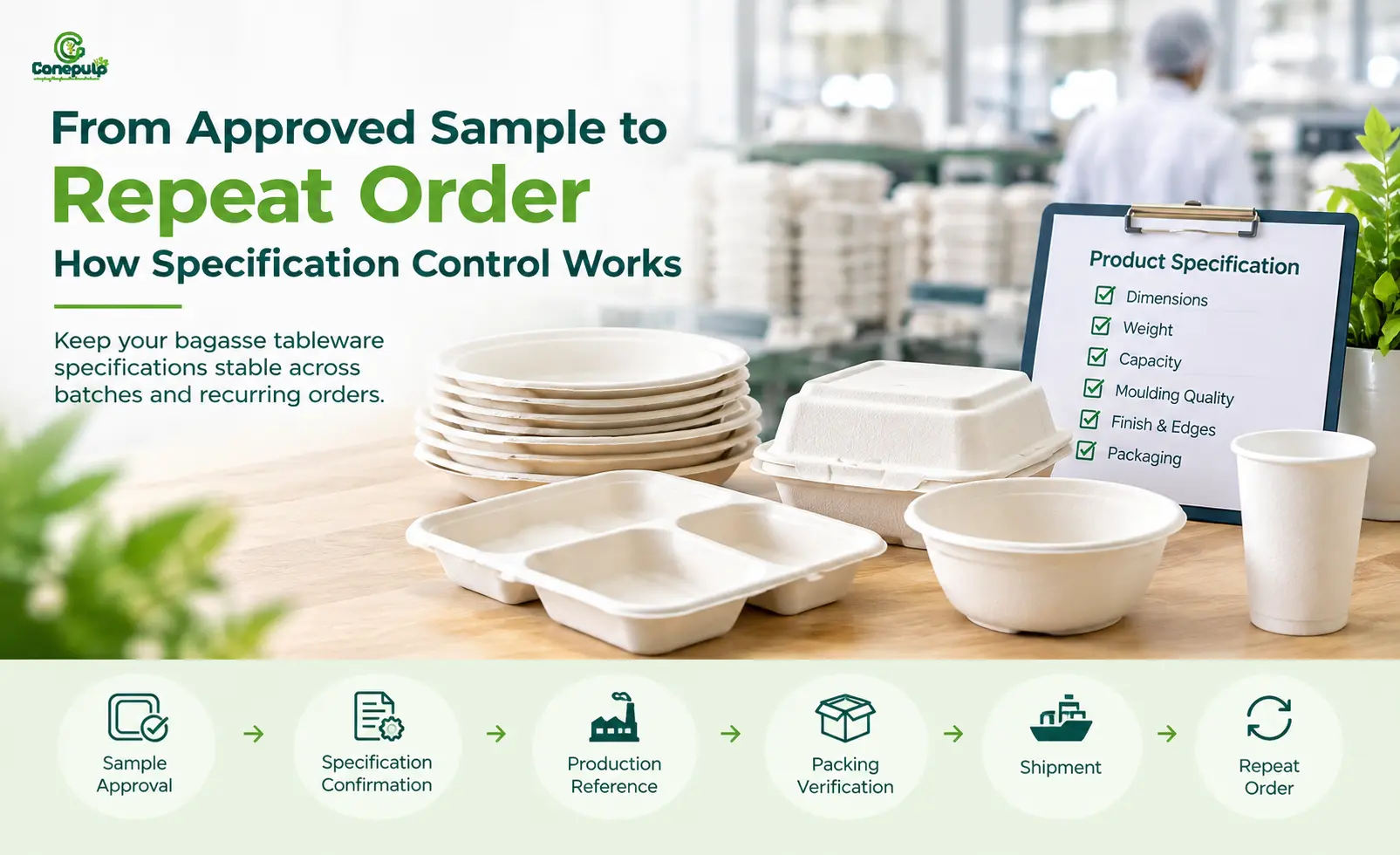
A buyer may approve one sample and still struggle to maintain the same product quality when the product is manufactured again weeks or months later. That gap between a successful sample and a consistent repeat order is where specification control matters. In B2B procurement, the approved sample is only the beginning of the commercial control process. The real objective is to preserve the product’s agreed characteristics through recurring production, packing and shipment stages so the buyer is ordering the same product, not a close visual approximation.
1. What Is an Approved Product Sample?
An approved sample in a bagasse tableware buying process is more than a visually acceptable product. It is the agreed reference for the product specification, the buyer’s expectations and the commercial relationship that follows. A buyer may review dimensions, weight, product shape, capacity, compartment configuration, edge quality, finish, and packaging expectations against that sample. These details become the practical benchmark for future production.
A sample is not an adequate production specification if it is only described in a photograph or a sales conversation. For sourcing and repeat orders, the buyer should align on the actual reference: the sample, the product description, and the commercial requirements that matter to the order. That can include the size, the configuration, the expected weight or strength, the intended use, and the handling or packaging assumptions that affect distribution and final customer experience.
The important point is that the sample should give the supplier a clear production reference, not just a visual target. If the buyer and supplier do not agree what matters in the sample, the order may drift later when production changes, tooling is updated, or different production batches are released.
2. Turn the Approved Sample Into a Clear Production Specification
Once the sample is approved, the next step is to convert it into a practical production specification. A B2B buyer should define which product attributes are commercially relevant and which must remain stable across repeat production. The specification should be clear enough that a supplier can produce the same product without relying on memory or on generic product descriptions.
In practice, the specification may include product dimensions, depth, weight, configuration, capacity, shape, finish, packaging configuration and the buyer’s expected commercial requirements. For some products, this can also include how the product should be packed, how cartons are labeled, the expected carton count, or any relevant artwork or private-label requirements. Not every item needs the same level of detail, but the buyer should decide which details matter to the commercial order and keep them documented.
The transition from sample to specification is the critical phase that prevents misalignment. Without a documented product reference, a supplier may assume a visual match is enough, while the buyer is expecting a more precise repeatable standard. The result is a common problem in repeat orders: the buyer approves one sample, but the later production batches differ in small but important ways.
3. Why Product Dimensions and Weight Need Consistent Control
In B2B buying, product dimensions and weight often matter more than they appear at first glance. Small changes in diameter, width, depth, weight or compaction can affect stacking, packaging utilization, food portioning, customer expectations and warehouse handling. A product can still look visually similar while performing differently in commercial use.
This is particularly relevant when the buyer is ordering multiple SKUs, cartons, or recurring shipments. If the approved sample is not paired with a clear product specification, it becomes difficult to know whether later batches are truly in line with the original standard. That is why product consistency should be reviewed in practical commercial terms, not only in visual terms.
The buyer should decide which metrics matter most for their business: product dimensions, weight, usable capacity, compartment layout, packaging fit or stacking behavior. Once those criteria are clear, they should be kept as part of the production reference, so repeat batches are measured against the same standard instead of being compared only to a general product image.
4. How Production References Help Prevent Specification Drift
Specification drift is a common issue in repeat manufacturing. It happens when the approved sample, the written specification, and the production batch are no longer aligned. In a small order this may not be obvious, but in a recurring commercial order or a large shipment, even small differences can become more significant in packing, stacking, customer satisfaction or distribution efficiency.
Specification drift can occur for many reasons: a small process change, a revision in tooling, a change in product setup, a different carton configuration, an undocumented buyer request, or a shift in raw material handling. The risk is not that this is always a serious defect; it is that the buyer may not know whether a later batch is still aligned with the original reference unless the specification is tracked and communicated clearly.
This is why the approved sample should be treated as a benchmark and the production reference should be controlled as a commercial item. A buyer who keeps the specification, sample reference, and packaging assumptions in one place is much better positioned to assess repeat orders than a buyer who relies only on memory or visual comparison.
5. What Should Be Checked During Repeat Production?
When the buyer moves from sample approval to repeat production, the checks should remain practical and transaction-based. The buyer should review the production batch against the agreed specification and look for dimension consistency, shape accuracy, finish quality, weight consistency, visible defects, product strength in real use, handling performance and packaging configuration. These checks are not limited to a single sample; they should be repeated whenever the batch is being evaluated for release.
The buyer should also distinguish between an in-process review and a final inspection. In-process checks can help catch production drift early, while final inspection confirms whether the batch meets the approved commercial specification before it is packed or shipped. This is a practical procurement principle because it reduces risk before the product enters the warehousing, shipping or customer-handling stage.
A repeat-order process should therefore include both the agreed specification and a verification method. Without a clear control method, the buyer cannot know whether the later batch is actually consistent with the approved sample or whether it has simply been visually accepted once and then produced on a different standard.
6. Sample Approval Does Not Mean “Approve Once and Forget”
One of the most common procurement mistakes is treating sample approval as a final event rather than the start of a controlled commercial relationship. A buyer may approve a sample, but unless the product specification, packaging configuration and approved reference are maintained, the repeat order can silently drift away from the original agreement.
This is why the approved sample should be retained as part of the commercial record. It should be paired with the specification, the packaging assumptions, the accepted product description and any buyer-approved revisions or changes. The goal is to ensure that the next commercial production cycle uses the same reference rather than a revised version that was never formally accepted.
This also matters when the buyer plans to expand the order, add new SKUs or move from a trial purchase into a recurring order. The approved sample becomes the reference point for those later decisions. Without it, the buyer is effectively making decisions without a stable baseline.
7. What B2B Buyers Should Ask Their Supplier
A practical buyer question set can make specification control much clearer. The most useful questions include: what specification is recorded against the approved sample, which product characteristics are checked during production, how is the approved specification referenced for repeat orders, how are changes in product or packaging communicated, what happens if a production batch differs from the approved sample, and what inspection records are retained after release?
Buyers should also ask whether the same packing configuration can be maintained across repeat shipments, whether the product is referenced by a documented SKU or specification, and how buyer-approved revisions are recorded. These are not abstract quality questions. They are part of a repeat-order procurement process, and they help prevent later commercial confusion.
A strong supplier discussion should lead to clear answers about the commercial reference and the production-change process. If those answers are vague, the buyer should treat the order as higher risk and ask for a more explicit specification record before increasing volume.
8. From Sample Approval to Repeat Shipment
The practical cycle looks like this: buyer requirement, sample development, sample review, specification confirmation, production reference, production and inspection, packing verification, shipment, and repeat order using the approved reference. Each step matters because each step adds another opportunity for the product definition to drift away from the original commercial expectation.
This is why buyers should not stop at sample approval. They should carry the approved specification into the production and shipment stages and confirm that the same commercial standard is being used for later orders. The result is a better repeat-order process, stronger communication with the supplier, and less risk of a buyer receiving a product that is visually similar but commercially different.
This is the practical value of specification control: it turns a sample into a usable production standard. That standard is what helps the buyer maintain consistency across repeat orders, expand purchasing with confidence and reduce avoidable production uncertainty over time.
Bulk Order Buyer Checklist
- Approved sample recorded as a commercial reference
- Product specification documented
- Dimensions, weight and capacity checked
- Packaging requirements confirmed
- Repeat-order production reference retained
- Change communication process agreed
- Inspection and batch review defined
- Packing configuration retained
Keep the Approved Sample as the Production Reference
Before moving from sample approval to repeat production, confirm the product specification, review the production reference, and align packaging and inspection expectations with your supplier.
The real value of sample approval is not only that the buyer likes the first item. It is that the approved sample becomes the reference for repeat production and repeat orders. When dimensions, weight, finish, packaging and product expectations are defined and kept under control, the buyer can move from one successful sample to recurring commercial supply with much less risk of specification drift.