

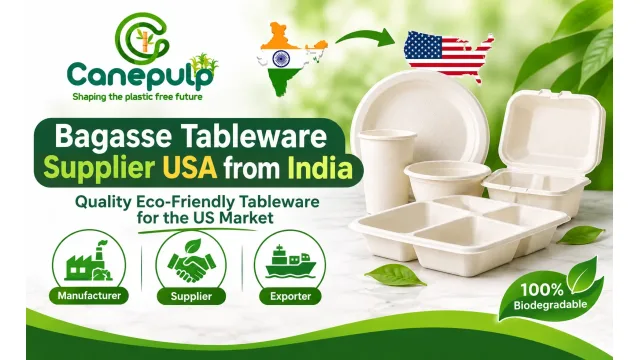
For a USA importer, the challenge is turning an India-origin quotation into an order that is ready for product, compliance, logistics and purchasing review. This checklist focuses on USA-specific importing steps: identify the exact SKU and intended use, verify product-specific documents, approve samples, confirm carton and shipment data, and align terms before production. It is not a general comparison of Indian manufacturers; use the manufacturer-evaluation checklist to compare candidates. Once requirements are clear, check the food-container product details, review the USA market page and read the India import guide before requesting a USA-market quote.
1. Why USA Buyers Source Bagasse Tableware from India
India has a developed agricultural and manufacturing context for sugarcane bagasse products. Bagasse is the fibrous residue left after sugarcane is processed, and it can be used as a feedstock for molded-fiber tableware and food packaging. For a USA buyer, the relevant question is not whether a supplier uses the word bagasse; it is whether the supplier can convert that material into a defined, repeatable product for the required market and food-service application.
An Indian manufacturing partner may offer access to a broad product range, including plates, bowls, compartment formats, meal trays, clamshells, food containers, cups and other molded-fiber formats. This can help a distributor or foodservice supplier build a multi-SKU program instead of buying each format from a separate source. The range still needs to be reviewed item by item because dimensions, weight, capacity, stacking and food-use suitability vary by SKU.
USA buyers also look to India for export-oriented manufacturing and recurring B2B supply. A useful partner should be able to discuss production planning, carton configuration, export documentation and communication during replenishment. India should not be treated as automatically the cheapest or best source; the commercial value depends on the manufacturer's actual control, product fit, documentation and ability to support the buyer's program over time.
2. What a USA Buyer Should Look for in an Indian Bagasse Tableware Supplier
A procurement team can evaluate a bagasse tableware supplier India USA program with a structured framework. The objective is to understand which parts of the order the supplier actually controls and which parts are passed to another party.
- Actual manufacturing capability: Ask where the product is manufactured, which formats are made there, and whether the supplier can explain the production flow for the quoted SKU.
- In-house or controlled raw-material processing: Ask how bagasse is prepared, converted into pulp or fiber feedstock, and controlled before molding. The answer should identify the supplier's level of operational control without relying on vague claims.
- Precision molding capability: Product geometry, wall profile, edge finish, drainage and stacking depend on the mold and the molding process. Ask how dimensions and repeatability are monitored.
- Product range: Review the full range against your USA sales program. A useful supplier may support plates, bowls, trays, containers and other formats, but every SKU still requires its own specification review.
- Specification control: Request dimensions, weight, capacity, material description, tolerances and intended use for each SKU. A product name alone is not an adequate specification.
- Quality-control process: Ask what is checked during incoming material handling, molding, finishing, packing and final release. The goal is to understand the checkpoints, not to collect generic quality language.
- Sample approval process: Confirm how the approved sample is identified and transferred into production records. Ask how changes to mold, weight, packaging or artwork are controlled after approval.
- Production consistency: A USA distributor needs repeatable supply, not only a good first sample. Ask how repeat orders are compared with the approved specification and how deviations are communicated.
- Export documentation capability: Confirm which commercial, packing, product and food-contact documents can be supplied for the specific order and destination.
- Private-label and OEM capability: If the program uses custom cartons, labels or packaging artwork, ask who manages artwork review, sample approval, packaging production and final packing.
- Packaging and carton control: Request carton quantity, dimensions, gross weight, net weight, markings and pallet or loading information for the quoted SKU.
- Communication and order support: Assess whether the supplier answers technical questions clearly, keeps a record of decisions and provides timely updates during production and shipment planning.
3. Manufacturer vs Trader vs Export Supplier
A manufacturer controls at least part of the production operation and should be able to explain the relationship between raw material, molding, inspection and packing. A trading company may source from one or more factories and coordinate the commercial relationship. An exporter or sourcing company may manage supplier selection, documents and logistics without owning the production equipment. These models can all be commercially workable, but the USA buyer should know which model applies.
Ask who owns or controls the mold, who approves the production sample, who performs the quality checks, who issues the packing information, and who is responsible if the shipped product differs from the approved specification. Also ask whether the company can show a consistent answer across sales, technical and export contacts. The purpose is not to reject traders automatically; it is to understand accountability before an order is placed.
For broader manufacturing context, review the bagasse tableware manufacturer in India overview. A page or presentation can provide useful context, but the USA buyer should still verify the exact SKU, documentation and production responsibility for the order being quoted.
4. What USA Buyers Should Request Before Ordering
Before approving a commercial quotation, request a product file that can be shared internally with purchasing, quality, logistics and compliance teams. It should be specific to the SKU rather than copied from a general catalogue.
- Product name, SKU or reference code and a clear product image.
- Dimensions, usable capacity, product weight and relevant tolerances.
- Material description and intended food-service application.
- Physical sample and a written sample approval record.
- MOQ per SKU, mixed-SKU options and carton quantity.
- Carton dimensions, gross weight, net weight and pallet or loading details.
- Production lead time and the process for confirming the production schedule.
- Quality-control information and the checks performed for the specific product.
- Relevant certificates, declarations and product-specific test reports.
- Export documentation and the documents supplied with the shipment.
- Packaging details, carton markings, artwork and private-label requirements.
- Quoted shipping terms, destination assumptions and any excluded charges.
5. Food-Contact and Compliance Documentation for USA Buyers
USA buyers should request current documentation relevant to the exact product and intended food-contact application. Documentation may include a material or product description, food-contact information, declarations, test reports, quality records or certificates that apply to the supplier and the defined product scope. The buyer should record the document date, issuing party, product reference and any limitations stated in the document.
FDA-related requirements are not the same as a blanket certificate that automatically approves every bagasse product for every USA use. The importer or responsible buyer should verify the current applicable requirements for the material, intended food, temperature, use conditions and distribution model. The supplier should be asked to provide the information available for the specific product, while the buyer should obtain its own regulatory or compliance advice when needed.
Check that the company name, product description, sample or SKU reference and test method match the quotation and the product being purchased. A document for one product should not automatically be used as proof for another product with different materials, coatings, dimensions or food applications. The certifications and compliance page provides context, but the final review must remain product-specific.
6. How to Evaluate a Bagasse Tableware Sample for the USA Market
Sample evaluation should reflect how the product will be sold and used in the USA. A restaurant supply company may need to test hot meals and sauces, while a catering distributor may focus on stacking, transport and high-volume service. A private-label buyer may also need to review how the product fits inside the proposed carton and how the packaging presents at wholesale level.
Use the sample with representative hot food, oily food and sauces where relevant. Review rigidity, edge finish, leakage or deformation, usable capacity, nesting, lid or closure fit, stacking and handling. Consider storage conditions, warehouse movement, case packing and transportation. The aim is to turn a visual sample into a written product specification that purchasing and quality teams can use later.
Record the approved dimensions, target weight, capacity, food-use notes, packaging configuration and any agreed tolerances. Keep the approved sample or a controlled reference image with the order record. For more detail on general sample review, the existing sample approval guide is useful; this USA-specific process adds the intended distribution and service context.
7. Bulk and Recurring Supply for USA Distributors
A USA distributor or wholesaler needs more than a successful first shipment. It needs repeat SKU availability, consistent specifications, stable carton packing and clear communication when demand changes. Before starting a program, ask how the supplier plans production for recurring orders and how it identifies the approved product reference.
For a multi-SKU program, define which items are core replenishment products and which items are seasonal or project-based. Confirm whether the supplier can maintain product weight, dimensions, capacity and carton quantity across repeat orders. Ask how artwork, labels and packaging changes are approved before production, and how a revised specification is separated from an earlier approved version.
Repeat-order reliability also depends on communication. A useful B2B supplier should communicate schedule changes, material or production constraints, packing information and document updates before the shipment is ready. This is different from negotiating a generic MOQ; it is about protecting the buyer's supply plan after the first order.
8. Private-Label Bagasse Tableware from India for USA Buyers
Private-label bagasse tableware usually involves more than printing a logo. The buyer must align product selection, packaging format, artwork, carton information, sample approval and production release. Start by selecting the product and confirming its specification. Then define the number of pieces per pack, carton quantity, label content, barcode or code requirements, artwork files and intended sales channel.
A practical workflow is: product brief, supplier review, artwork preparation, packaging proof, sample approval, packaging approval, production scheduling, final inspection and export shipment. Keep the product sample and approved packaging proof together in the order record. If the buyer changes artwork or carton quantity after approval, the change should be documented before production continues.
This approach supports both private label bagasse tableware USA programs and OEM bagasse tableware USA inquiries. It also helps separate product approval from branding approval so that a packaging change does not accidentally change the agreed product specification.
9. Questions USA Buyers Should Ask an Indian Bagasse Tableware Manufacturer
A procurement call is more useful when the buyer asks questions that reveal operational control. The following list can be used in a supplier introduction call or written RFQ:
- Where is the product manufactured, and which part of production do you control?
- What bagasse processing or raw-material preparation capability is available for this SKU?
- Which molding process and product specifications apply to the quoted item?
- Can you provide dimensions, weight, capacity and material information?
- Can you provide a physical sample before bulk production?
- How is the approved sample transferred into the production record?
- What quality checks are performed during production and final packing?
- How are specification changes controlled between repeat orders?
- What current documents are available for the specific product and food use?
- What is the MOQ per SKU and can multiple SKUs be combined?
- What carton quantity, carton dimensions and gross/net weights apply?
- Can you support recurring orders for USA distribution?
- Can you handle private-label packaging and artwork approval?
- What export documents are provided with the shipment?
- Which shipping terms can you quote and what destination assumptions apply?
- Who is the main contact for production, quality and export coordination?
10. USA Buyer Checklist Before Placing a Bulk Order
Use this short checklist as a final procurement review before releasing a commercial order:
- Supplier or manufacturer identity verified.
- Product specification confirmed.
- Sample approved.
- Intended food use reviewed.
- Relevant documentation reviewed.
- MOQ confirmed.
- Carton packing confirmed.
- Product weight confirmed.
- Private-label requirements confirmed.
- Production lead time confirmed.
- Export documentation confirmed.
- Shipping terms confirmed.
- Final commercial quotation confirmed.
- Approved specification retained.
11. Why Supplier Verification Matters More Than Comparing Unit Price Alone
Unit price is important, but it is only one part of commercial risk. A supplier that cannot maintain the approved specification may create inconsistent product across a distributor's inventory. Poor communication can delay replenishment or leave a buyer without the information needed for a customer inquiry. Packing differences can change freight planning, storage requirements and damage risk. Documentation gaps can delay an internal quality review or a customer approval.
Verification helps the buyer understand these risks before they become expensive. Ask who controls production, how the product is measured, how changes are recorded, which documents are current, and how the supplier supports repeat orders. This is not the same as repeating a landed-cost calculation; it is a supplier-control review that protects the commercial program around the order.
12. Why Canepulp for USA B2B Buyers
Canepulp supplies bagasse tableware and molded-fiber food packaging for B2B buyers evaluating plates, bowls, meal trays, clamshells, containers, cups and related formats. USA importers, distributors and private-label buyers can discuss product specifications, samples, MOQ, carton information, documentation and export requirements for the intended program.
The sourcing conversation can include manufacturing capability, bagasse processing, precision molding, quality-control practices, product specification control, bulk supply and export support. Buyers with a private-label or OEM requirement can also discuss product selection, custom packaging, artwork review and the approval process before production.
Review the bagasse tableware product range, manufacturing process, sustainability approach and certifications and documentation pages before sending a product brief. These pages provide context; the final quotation and product approval should always be based on the exact SKU, intended use, destination and order requirements.
Bulk Order Buyer Checklist
- Supplier or manufacturer identity verified
- Product specification confirmed
- Sample approved
- Intended food use reviewed
- Relevant documentation reviewed
- MOQ confirmed
- Carton packing confirmed
- Product weight confirmed
- Private-label requirements confirmed
- Production lead time confirmed
- Export documentation confirmed
- Shipping terms confirmed
- Final commercial quotation confirmed
- Approved specification retained
Looking for a Bagasse Tableware Supplier in India for the USA Market?
Request product specifications, samples, MOQ, documentation and private-label options from Canepulp for your USA B2B sourcing program.
A USA buyer looking for a bagasse tableware supplier USA from India should evaluate the complete sourcing relationship, not only the unit price. Manufacturing control, product specification, sample approval, food-contact documentation, carton information, private-label capability, export support and repeat-order communication all affect the success of a B2B program. Request a clear product file and discuss your intended food use, sales channel, quantities and destination before placing a bulk order. Looking for a bagasse tableware supplier in India for the USA market? Request product specifications, samples, MOQ, documentation and private-label options from Canepulp.