

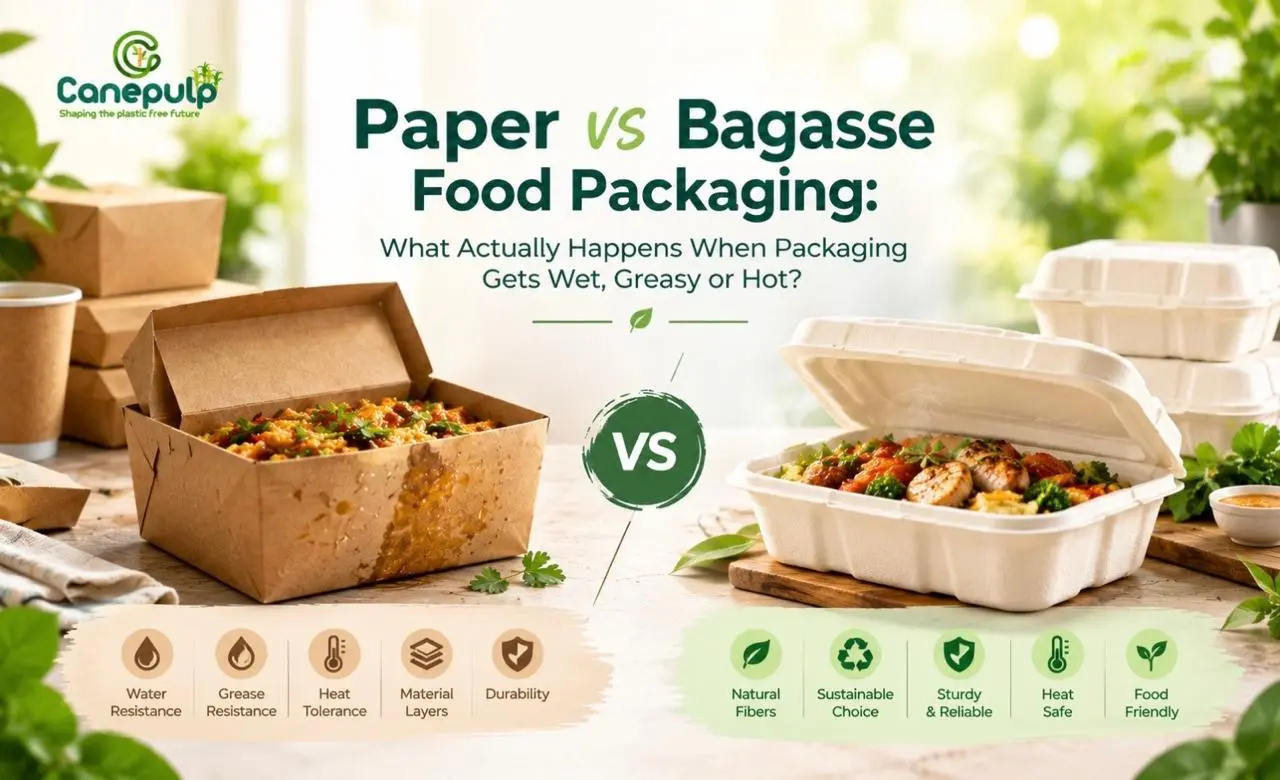
When hot curry, oily biryani, soup or a sauce is packed for takeaway, the package has to do more than hold its shape on a shelf. Heat, moisture, grease, food composition and the time before serving all place demands on the material. For buyers, the question is not simply whether paper or bagasse is “better.” It is what each product is made of, how it is designed to perform, and whether its documented use matches the meal and service conditions.
Paper and molded-fiber bagasse are fiber-based categories, but neither name describes every construction. Paper may be uncoated, coated or lined; bagasse products also differ in process and treatment. Neither label alone predicts performance. [1][2][3]
Paper Packaging Does Not Always Mean “Just Paper”
Paper and paperboard consist primarily of cellulose fibers. Uncoated porous structures can absorb water or allow oil through, so foodservice products may need barriers to protect their structure with wet or greasy food. Grade, wet-strength design, geometry and exposure affect performance. [1][2]
Some packs are uncoated; others have surface coatings, waxes, laminates or liners, including polyethylene (PE) or polylactic acid (PLA). These technologies vary. A “paper” label does not show the complete construction, and not every paper container has a polymer layer. Check documentation for the exact product. [1][2]
Ask what the substrate and barrier are, if present, and what use the complete article is documented for.
Why Does Paper Need a Barrier?
Water and moisture
Untreated cellulose fibers absorb moisture and may soften or lose stiffness. The degree depends on grade, construction, wet-strength design and exposure. A barrier can slow wetting but does not guarantee leakproof performance. [1][2]
Oil and grease
Oil can pass through porous paper, so fries, fried meals or pizza may need a grease barrier that a dry-food carton does not. Coatings can reduce penetration, but performance depends on the product and test conditions. [1][4]
Heat
Heat, steam, food moisture and the filled package’s load all affect use conditions. Suitability depends on construction, temperature and contact time; “paper” alone does not specify heat resistance. [1][2]
What Happens When Hot Food Goes into Paper Packaging?
Soup, curry, biryani and fried food create different combinations of heat, moisture, oil and contact time. Steam can condense on a lid, sauce can pool at a seam, and filled packs may be stacked or transported. Specify these conditions; none alone proves a package will fail.
Food-contact compliance and physical performance are separate checks. A rigid pack is not automatically compliant; compliance does not guarantee leak resistance. EU Regulation 1935/2004 sets general food-contact requirements, with applicable conditions and material-specific rules to consider. [3][5]
Migration is not automatic. Transfer depends on the substance, material, food or simulant, temperature and time. Paperboard studies use defined conditions, so results should not be generalized to every package or meal. [6]
Tomato-based sauces may be relevant to an application assessment, but acidity does not make every paper pack unsuitable. Identify the menu, temperature, contact time and reheating step, then check whether the product was evaluated for that use.
What About Polymer Linings on Paper?
Barrier layers can reduce moisture or grease penetration, support sealing or protect food. A PE-lined cup, coated tray and uncoated carton are different constructions; other packs may use PLA, wax or dispersion coatings. Confirm composition in product documentation. [1][2]
A polymer layer is a material component, not by itself a safety warning. It can affect repulping, recycling, compostability claims and sorting. Acceptance varies by package and facility, so check the complete construction and local requirements. [3][7]
What Happens When Paper Packaging Gets Greasy?
Grease resistance matters for fries, fried meals, burgers, pizza, oily biryani and saucy dishes. Untreated porous paper may stain through or weaken at a fold. Treatments can reduce penetration, but results for one coating do not certify another product. [4][8]
Test with the food or a suitable simulant at realistic temperature and hold time. Check seams, corners, lids and folds, not just the base.
What Happens When Bagasse Packaging Gets Wet or Greasy?
Bagasse is fibrous residue from sugarcane processing that can be pulped and molded. Performance depends on fiber preparation, density, wall thickness, geometry, drying and treatment. Molded-pulp research describes varied processes; products should not be assumed equivalent. [7]
Plates, bowls, trays and takeaway containers are designed for different uses. Hot-food suitability, grease resistance and wet strength remain product-specific; confirm them in specifications and samples rather than infer them from fiber type.
One study tested tableware made from a specific sugarcane-and-bamboo fiber hybrid. Its results do not certify all bagasse products; request evidence for the exact SKU and intended use. [9]
Paper vs Bagasse: Material Behavior at a Glance
| Factor | Uncoated paper or fiber | Coated or lined paper | Molded-fiber bagasse |
|---|---|---|---|
| Moisture resistance | Can absorb water and soften; grade and wet-strength design matter. | Barrier can slow wetting; seams and coating continuity still matter. | Depends on molding, density, wall design and any treatment. |
| Grease resistance | Oil may penetrate a porous sheet; verify for oily foods. | Coating or liner may improve resistance; test the finished pack. | Product formulation and surface treatment determine performance. |
| Hot-food performance | Depends on basis weight, shape, moisture and exposure time. | Depends on substrate, barrier, seals and intended temperature. | Depends on SKU design and validated hot-food application. |
| Structure when wet | May lose stiffness as fibers take up moisture. | Barrier may reduce liquid contact, but cannot guarantee against all leaks. | Varies with fiber, forming process, wall thickness and food load. |
| Barrier layer | May have no added barrier. | May use PE, PLA, wax, dispersion coating or another system. | May be untreated or use a product-specific additive or coating. |
| Recycling | Depends on food residue and local paper collection rules. | Coating or laminate may affect repulping and mill acceptance. | Depends on local collection, contamination and available fiber-processing routes. |
| Compostability | Do not infer from fiber alone; inks, adhesives and contamination can matter. | Depends on the complete construction and applicable certification. | Depends on the complete product, certification scope and composting conditions. |
This comparison describes considerations, not guaranteed outcomes or a material ranking. A buyer should compare actual product specifications and test results for the intended menu and service conditions. [1][2][7]
The Hidden Question: What Is Actually in the Packaging?
An outside view may not reveal a liner, a thin surface coating or a treatment applied during manufacturing. Before approving a package, buyers can ask the supplier for clear answers to these questions:
- What is the primary substrate and the complete material construction?
- Is there a coating, liner, wax or laminate? If so, what material is it?
- What food-contact declaration or compliance documentation applies to the exact SKU and destination market?
- If PFAS-free is a requirement, what does the claim cover and what product-specific evidence supports it?
- What temperature, food types and contact duration are within the product’s intended use?
- What grease, leak or moisture testing has been completed, and under which method and conditions?
- What compostability certification applies to the finished package, which standard and facility conditions does it cover?
- Are technical datasheets, test reports and certificates current and traceable to the product supplied?
Compostable Does Not Mean “Disappears Anywhere”
Compostability is condition-dependent. Industrial composting uses managed conditions that differ from a home compost pile, soil, landfill or the natural environment. A certification applies to the tested product construction and standard; it should not be generalized to every product made from the same broad material. Coatings, inks, adhesives and other components may be part of the certification scope. [10][11]
The European Commission notes that compostable and biodegradable products should be considered in relation to their conditions, applications and end-of-life management. ASTM D6400 is one standard for plastics designed for aerobic composting in municipal or industrial facilities; it is not a promise that an item will break down in any setting. Buyers should check the exact certificate, applicable standard, disposal instructions and whether the destination market has a facility that accepts the product. [10][11]
What Should Foodservice and B2B Buyers Check?
Start with the use case, then request evidence for the product that will actually be ordered. A useful procurement review covers:
- Hot foods: intended fill and serving temperatures, holding time, load, lid fit and food-contact compliance.
- Oily or saucy foods: grease and leak resistance, seams, base shape and testing with a relevant food or simulant.
- Acidic foods: confirm suitability for the food type and applicable food-contact assessment; do not assume from the material name.
- Heating: verify microwave or other reheating instructions separately; hot-fill performance does not automatically authorize reheating.
- Export orders: confirm SKU specifications, carton dimensions, case pack, palletization, certificates and destination-market documentation.
- Sustainability claims: record exact material composition, coatings, certification, standard and end-of-life requirements.
Where Bagasse Packaging Fits
Molded-fiber bagasse can be a fiber-based option for foodservice applications where the product meets the buyer’s temperature, strength, grease, moisture and end-of-life requirements. Canepulp manufactures sugarcane bagasse tableware and molded-fiber food packaging for importers, distributors, wholesalers, foodservice suppliers, hospitality and catering buyers, OEM programs and private-label brands.
Buyers can review the intended format, then verify the exact specification: bagasse plates, bagasse bowls, bagasse food containers, bagasse clamshell boxes and bagasse meal trays. For supplier qualification, see Canepulp’s bagasse tableware manufacturing, OEM and private-label manufacturing and certifications information.
There is no universal “paper versus bagasse” answer. The better procurement decision is the package whose verified construction and performance match the food, temperature, service duration, market rules and realistic end-of-life route.
Key Takeaways
- Paper food packaging is not all the same: products may be uncoated, coated, lined or laminated.
- Barriers can improve moisture or grease performance, but they change material construction and can affect recycling or compostability routes.
- Hot, wet, oily and acidic foods create different use conditions; neither material name alone guarantees performance.
- Food-contact migration is assessed for specific materials and conditions; heat does not automatically mean chemicals migrate into food.
- Bagasse is molded fiber from sugarcane processing residue, but individual products may differ in formulation, coatings and performance.
- “Compostable,” “plastic-free” and “PFAS-free” are separate claims that need product-specific evidence.
- B2B buyers should compare the complete construction, specifications, testing, compliance documents and end-of-life requirements.
Frequently Asked Questions
Is all paper food packaging plastic-free?
No. Some paper products are uncoated; others have a PE or PLA liner, wax or another barrier. Check the product construction rather than assuming from its paper appearance. [1][2]
Does paper food packaging always have a plastic coating?
No. Coatings and liners vary by product and application. A supplier should be able to identify whether the specific item is uncoated, coated or laminated.
Why does paper need a coating for greasy food?
Oil can pass through porous fiber structures. A grease-resistant treatment or coating can reduce penetration, but its performance should be tested for the intended food and contact time. [4][8]
Is bagasse packaging better for hot food?
There is no universal answer. Compare the exact bagasse and paper products against the food, temperature, holding time, structural load and supplier instructions.
Can bagasse packaging get wet?
It can be used for some moist-food applications when designed for them, but moisture resistance and wet strength vary by product. Confirm product-specific testing and instructions.
Is bagasse packaging compostable?
Some products may be certified for particular composting conditions. Verify the finished product’s certification and whether a suitable local facility accepts it; do not infer home compostability from the fiber alone. [10][11]
Is coated paper recyclable?
It depends on the coating, package construction, food residue and local mill or collection system. Ask the relevant recycler or waste service about the specific package.
What should businesses ask packaging suppliers?
Ask for material construction, food-contact documentation, use-temperature and contact-time limits, grease or leak test conditions, certification scope, and technical datasheets for the exact SKU.
Paper and bagasse are not single, uniform materials, and food packaging is an engineered product rather than a label. The practical comparison is between the complete package constructions under the actual food, temperature, contact time, performance, compliance and disposal conditions a business faces. Specify those conditions, review product documentation and validate samples before scaling a purchase.
Scientific References
- Khwaldia K, Arab-Tehrany E, Desobry S. Biopolymer coatings on paper packaging materials. Comprehensive Reviews in Food Science and Food Safety. 2010;9(1):82–91. doi:10.1111/j.1541-4337.2009.00095.x.
- Tyagi P, Salem KS, Hubbe MA, Pal L. Advances in barrier coatings and film technologies for achieving sustainable packaging of food products: a review. Trends in Food Science & Technology. 2021;115:461–485. doi:10.1016/j.tifs.2021.06.036.
- European Commission. Food Contact Materials. General information on EU food-contact requirements and material-specific legislation.
- European Parliament and Council. Regulation (EC) No 1935/2004 on materials and articles intended to come into contact with food. 2004.
- Baele M, Vermeulen A, Claes M, Ragaert P, De Meulenaer B. Migration of surrogate contaminants from paperboard to foods: effect of food and surrogate properties. Food Additives & Contaminants: Part A. 2020;37:2165–2183. doi:10.1080/19440049.2020.1778184.
- Semple K, et al. Moulded pulp fibers for disposable food packaging: a state-of-the-art review. Food Packaging and Shelf Life. 2022;33:100908. doi:10.1016/j.fpsl.2022.100908.
- Liu C, et al. Biodegradable, Hygienic, and Compostable Tableware from Hybrid Sugarcane and Bamboo Fibers as Plastic Alternative. Matter. 2020;3(6):2066–2079. doi:10.1016/j.matt.2020.10.004.
- Sheng J, Li J, Zhao L. Fabrication of grease resistant paper with non-fluorinated chemicals for food packaging. Cellulose. 2019;26:6291–6302. doi:10.1007/s10570-019-02504-y.
- Zhang W, Xiao H, Qian L. Enhanced water vapour barrier and grease resistance of paper bilayer-coated with chitosan and beeswax. Carbohydrate Polymers. 2014;101:401–406. doi:10.1016/j.carbpol.2013.09.097.
- European Commission. Bio-based, biodegradable and compostable plastics: EU policy framework. Guidance on application conditions, standards and end-of-life management.
- ASTM International. ASTM D6400-23: Standard Specification for Labeling of Plastics Designed to be Aerobically Composted in Municipal or Industrial Facilities. 2023.