

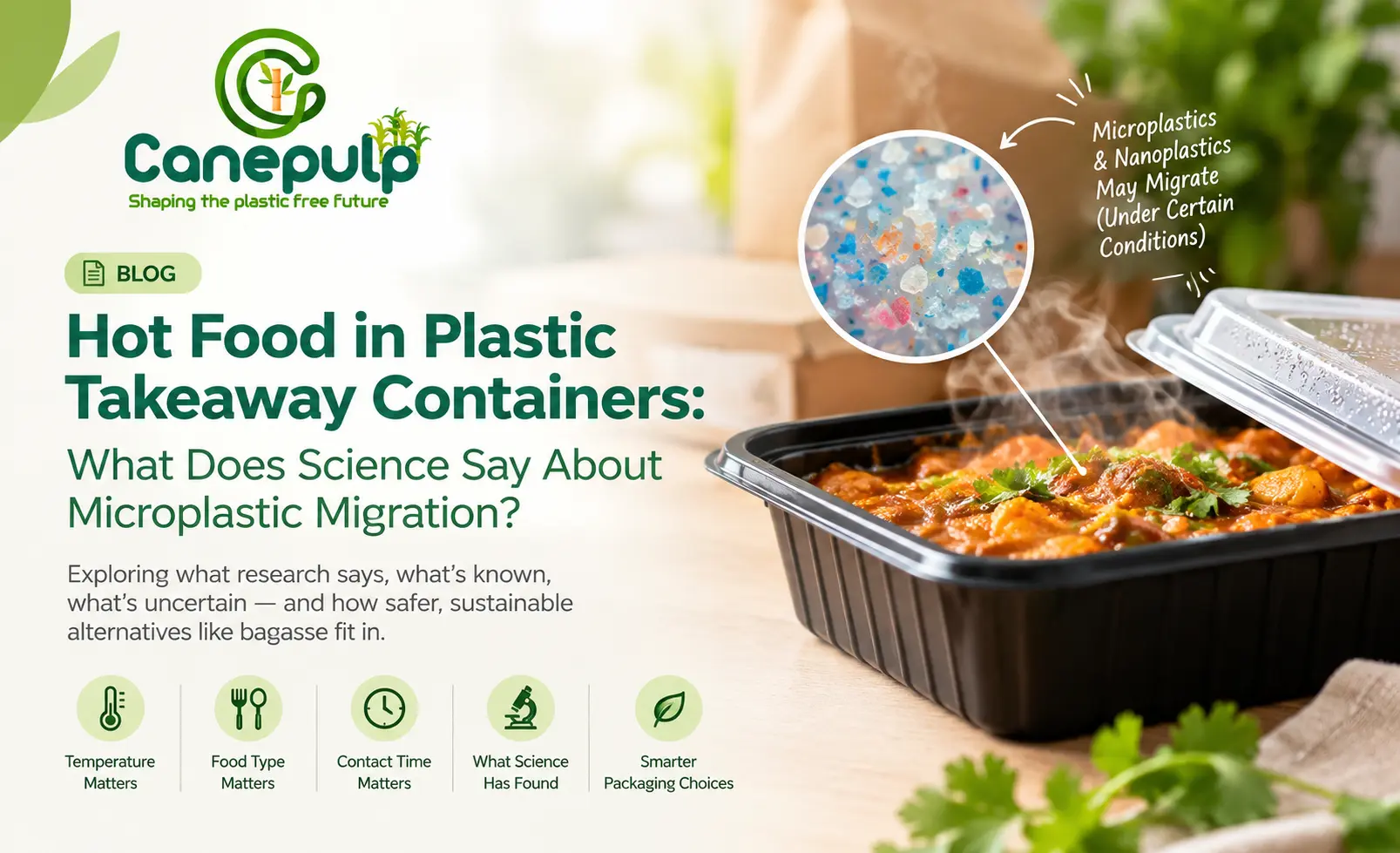
Hot meals are packed, transported, reheated and stored in many kinds of food-contact packaging. That makes a practical question worth asking: can tiny plastic particles move from a container into food, particularly when the food is hot? Laboratory studies have reported particle release from some food-contact plastics under specific test conditions. They do not show that every plastic takeaway container releases the same amount, that every hot meal contains microplastics from its packaging, or that an ordinary takeaway meal has been shown to cause disease. [1][2]
This distinction matters to consumers and to food businesses. Temperature, contact time, food composition, polymer, package condition and heating method can all matter to the test scenario, while results from one material or laboratory setup cannot automatically be applied to another. Human-health implications at typical dietary exposure remain an active research question. This article summarizes what has been measured, where uncertainty remains, and how procurement teams can make packaging decisions based on the intended application rather than fear.
Why Does Packaging Matter When Food Is Hot?
Food-contact packaging is designed for defined uses. A container may be intended for a particular food, fill temperature, holding time or reheating method; it should not be assumed suitable for every combination. Heat can change how materials behave and can affect the transfer of substances at a food-contact surface. Particle release is a related but distinct question: evidence about migration of chemicals does not, by itself, measure microplastic particles, and a particle study does not establish the migration of every chemical in that material.
For example, curry, dal, biryani, oily gravies, noodles and soup differ in temperature, moisture, fat content and acidity. These differences are useful when defining the application and the conditions for testing. They do not mean that any one of these foods automatically becomes contaminated. Research on food-contact particles remains limited, and the result for one food simulant or package should not be treated as a universal result for all menus.
Can Plastic Food Containers Release Microplastics?
Yes, particle release from some plastic food-contact items has been reported in laboratory studies. One frequently cited experiment examined polypropylene infant feeding bottles during sterilization and formula preparation. The authors reported that preparation conditions, including hot water, affected the number of particles released in their tested system. This is evidence about those bottles and that experimental workflow; it is not a direct measurement of takeaway curry, restaurant containers or typical consumer exposure. [3]
Another laboratory study reported micro- and nanoscale particles released from selected polymer tea bags steeped at 95°C. The study concerned the particular tea-bag materials and method used, not ordinary takeaway tubs. A published comment raised questions about the analytical approach, and the study authors later responded. The exchange is a useful reminder that particle identification and counting methods are technically challenging, especially at very small sizes. [4][5][6]
Taken together, these studies support a careful conclusion: release can occur under some defined experimental conditions. They do not establish that all plastic containers behave alike, give a single migration figure for “hot food,” or prove the health impact of particles detected in a laboratory test.
What Factors Can Affect Particle Release or Migration?
Temperature. In the polypropylene bottle study, the preparation sequence and hot-water conditions were relevant to measured release. The tea-bag study also used hot water. These are reasons to test the intended temperature range, not proof that every increase in temperature produces the same increase in particles. Packaging design, polymer, surface and test method differ. [3][4]
Contact time. Food may remain in a container for minutes during service or for hours during delivery and storage. Longer contact is a sensible condition to include in an application-specific assessment. However, a longer hold should not be assumed to produce a predictable or proportional increase in particle release without measurements for that package and use case.
Food composition. Aqueous dal, oily curry, acidic sauces and dry biryani present different contact conditions. Food-contact assessments use different food types or simulants to represent intended uses. For particulate release, the available evidence does not support a simple ranking such as “oily food always releases more” or “acidic food is always unsafe.” Buyers should identify the foods they actually pack and request relevant test information.
Plastic type and package condition. “Plastic” covers different polymers, formulations, additives, manufacturing processes and package structures. The polypropylene bottle and tea-bag experiments are not interchangeable, and neither represents every plastic takeaway container. Surface damage, repeated use and aging can also change the condition of an item; if a package is intended for reuse, the reuse conditions should be part of its testing and instructions.
Heating method. Filling a container with hot food, reheating food in a microwave, pouring boiling water into a package and sterilizing a bottle are different exposures. A package suitable for hot-fill service is not automatically suitable for microwave reheating, and vice versa. Follow the manufacturer’s stated food-contact and heating instructions, and do not infer a reheating approval from appearance alone.
What Does Scientific Research Actually Show?
The 2020 Nature Food study by Li and colleagues investigated microplastic release from polypropylene feeding bottles during infant-formula preparation. It used a defined preparation sequence and reported that bottle sterilization and formula preparation could generate particles in that system. The paper is important because it measured a food-contact product under heat-related conditions. Its exposure estimates are scenario-specific; they should not be presented as measured exposure from restaurant takeaway packaging or as a health-risk estimate for adults eating hot meals. [3]
Hernandez and colleagues’ 2019 tea-bag experiment reported large estimated particle counts after steeping selected plastic tea bags in hot water. Those results were tied to the study’s bags, steeping conditions, particle-identification method and assumptions used to estimate counts. The subsequent published comment and response show that methods for distinguishing plastic particles from other material, and for quantifying very small particles, deserve careful scrutiny. This study is relevant as a demonstration that packaging-specific tests can detect particles; it cannot establish what is released by an unrelated food container. [4][5][6]
EFSA’s 2016 scientific statement focused particularly on microplastics and nanoplastics in seafood. It discussed gaps in occurrence data, analytical methods and assessment, including challenges for the smallest particles. WHO’s 2022 review considered dietary and inhalation exposure and identified important evidence gaps for assessing possible health implications. These assessments are not proof that exposure is harmless; they explain why current evidence cannot support a simple, universal conclusion about everyday exposure and health. [1][2]
Microplastics vs Nanoplastics: What Is the Difference?
Microplastics are plastic particles commonly discussed below about 5 millimetres, although studies use different lower size cutoffs and definitions. Nanoplastics are much smaller particles in the nanoscale; operational definitions vary across scientific fields. The distinction matters because particle size can affect how a sample is collected, identified and counted, and smaller particles may require different analytical tools.
Researchers must control contamination from laboratory air, water, clothing and equipment, identify polymer composition, and report the size range their method can detect. A method that counts particles above a certain size cannot rule out smaller particles. This makes comparisons between studies difficult and is one reason that a reported particle count should always be read alongside the study’s methods and limitations. [1][2][5]
Do Microplastics in Food Cause Health Problems?
Microplastics have been reported in environmental samples and in some human biological samples. For example, a 2019 case series reported microplastics in stool samples. Such detection can help researchers study exposure, but it does not show exactly how much came from a particular meal, food package or route of exposure. [7]
The key distinction is between “a substance has been detected” and “the detected exposure has been proven to cause a specific disease.” Detection alone does not establish dose, absorption, biological effect or causation. Laboratory and animal studies can investigate possible mechanisms, but they do not directly determine the risk from typical dietary exposure in people.
WHO’s review describes substantial research needs, including better measurement of exposure and more information on the health effects of particles of different sizes and compositions. The long-term health implications of dietary microplastic exposure remain under study. This article is not a medical assessment, and it does not make an independent conclusion about individual risk. [1]
What We Know — and What We Still Don’t Know
| What research supports | What remains uncertain |
|---|---|
| Particle release has been reported from particular food-contact items under defined laboratory conditions. [3][4] | Typical everyday dietary exposure from all takeaway packaging and foods. [1][2] |
| Temperature and preparation conditions mattered in specific experiments. [3][4] | How results translate to ordinary hot meals, different packaging designs and real delivery timelines. |
| Different materials and test methods can produce different findings. [2][3][4] | How food composition, package age and surface condition affect particle release across products. |
| Researchers have reported particles in some human samples. [7] | Whether typical dietary exposure causes a particular long-term health outcome. [1] |
| Particle size and identification methods affect what a study can detect. [1][2][5] | Exposure to the smallest nanoplastics and how different sizes behave in the human body. |
What This Means for Food Delivery and Takeaway Packaging
Hot meals are commonly transported in food-contact packaging, including different types of plastic, paper-based, coated and molded-fiber containers. The packaging, food, temperature and transport time vary from order to order. The cited laboratory studies do not identify contamination by any named delivery platform, restaurant, cloud kitchen or takeaway service, and there is no basis here to make that accusation.
For consumers, a practical approach is to use packaging as directed and avoid reheating food in a takeaway container unless its manufacturer says it is suitable for that method and temperature. Moving food to cookware or a reusable dish designed for reheating is a straightforward alternative when instructions are unclear. This advice is about matching the container to its stated use, not a claim that a specific delivered meal is contaminated.
For operators, consistency matters. A delivery container should suit the temperature and food type at packing, stay functional during the expected holding and transport time, and be compatible with the reheating instructions, if any, that are communicated to customers.
How Food Businesses Can Think About Packaging Selection
Procurement teams can turn a broad concern into a specific packaging specification. Rather than choosing a material based only on a label such as “eco-friendly,” document the actual foodservice application and ask suppliers for product-specific information. A useful review can include:
- Intended food types, including watery, oily, acidic, dry or mixed meals.
- Fill temperature, serving temperature, expected contact duration and delivery conditions.
- The packaging material, construction, coatings or treatments, and the supplier’s food-contact instructions.
- Whether the product is intended for hot filling, cold storage, microwave heating, oven use or repeated use; do not assume one approval covers another.
- Applicable food-contact regulations and declarations for the destination market.
- Application-specific performance or migration testing, with the test method, food simulant, temperature and duration documented.
- Disposal instructions and the local collection or composting infrastructure relevant to the product.
Where Can Bagasse and Molded-Fiber Packaging Fit?
Sugarcane bagasse is fibrous material left after sugarcane juice extraction. It can be processed and molded into foodservice products such as bagasse plates, bagasse food containers and clamshell takeaway boxes. Molded-fiber products can offer a plastic-free packaging option for applications where their specifications and food-contact requirements are suitable.
“Plant fiber” is a material description, not a universal safety or performance guarantee. Products can differ in fiber blend, coatings, additives, manufacturing controls and intended use. Buyers should verify product-specific food-contact information, temperature conditions, testing or certifications, and end-of-life instructions. No packaging should be described as risk-free or suitable for every food and heating method without evidence for that claim.
Canepulp manufactures sugarcane bagasse tableware and molded-fiber food packaging for bulk buyers, distributors, importers, foodservice businesses, OEM programs and private-label brands. Buyers comparing options can review our compostable packaging solutions, bagasse tableware manufacturing and OEM and private-label capabilities, then assess specific products against their intended application.
Key Takeaways
- Laboratory studies have reported particle release from some food-contact plastics under specific conditions; they do not represent every plastic container or every hot meal.
- Temperature, food, contact time, package type and heating method should be considered together when defining an application-specific test.
- Particle detection is not the same as proof that typical dietary exposure causes a particular disease; long-term human-health implications remain under study.
- Food businesses should select packaging based on intended use, supplier instructions, applicable compliance requirements and relevant testing.
- Bagasse and molded fiber can be options for suitable applications, but product-specific food-contact performance and disposal guidance still matter.
The most accurate answer is conditional: researchers have measured particle release from particular food-contact items under some laboratory conditions, including heat-related preparation, but those results do not prove that all plastic takeaway containers contaminate hot food or that detected particles cause disease at everyday exposure levels. Better methods and real-use evidence are still needed. For businesses, the practical next step is to define the food, temperature, contact time and heating conditions, then choose and validate packaging for that application.
Scientific References
- World Health Organization. Dietary and inhalation exposure to nano- and microplastic particles and potential implications for human health. 2022. ISBN 978-92-4-005460-8.
- EFSA CONTAM Panel. Presence of microplastics and nanoplastics in food, with particular focus on seafood. EFSA Journal. 2016;14(6):4501. doi:10.2903/j.efsa.2016.4501.
- Li D, et al. Microplastic release from the degradation of polypropylene feeding bottles during infant formula preparation. Nature Food. 2020;1:746–754. doi:10.1038/s43016-020-00171-y.
- Hernandez LM, et al. Plastic Teabags Release Billions of Microparticles and Nanoparticles into Tea. Environmental Science & Technology. 2019;53(21):12300–12310. doi:10.1021/acs.est.9b02540.
- Busse K, et al. Comment on “Plastic Teabags Release Billions of Microparticles and Nanoparticles into Tea.” Environmental Science & Technology. 2020;54(21):14134–14135. doi:10.1021/acs.est.0c03182.
- Hernandez LM, et al. Response to Comment on “Plastic Teabags Release Billions of Microparticles and Nanoparticles into Tea.” Environmental Science & Technology. 2020;54(21):14136–14137. doi:10.1021/acs.est.0c06422.
- Schwabl P, et al. Detection of Various Microplastics in Human Stool: A Prospective Case Series. Annals of Internal Medicine. 2019;171(7):453–457. doi:10.7326/M19-0618.