

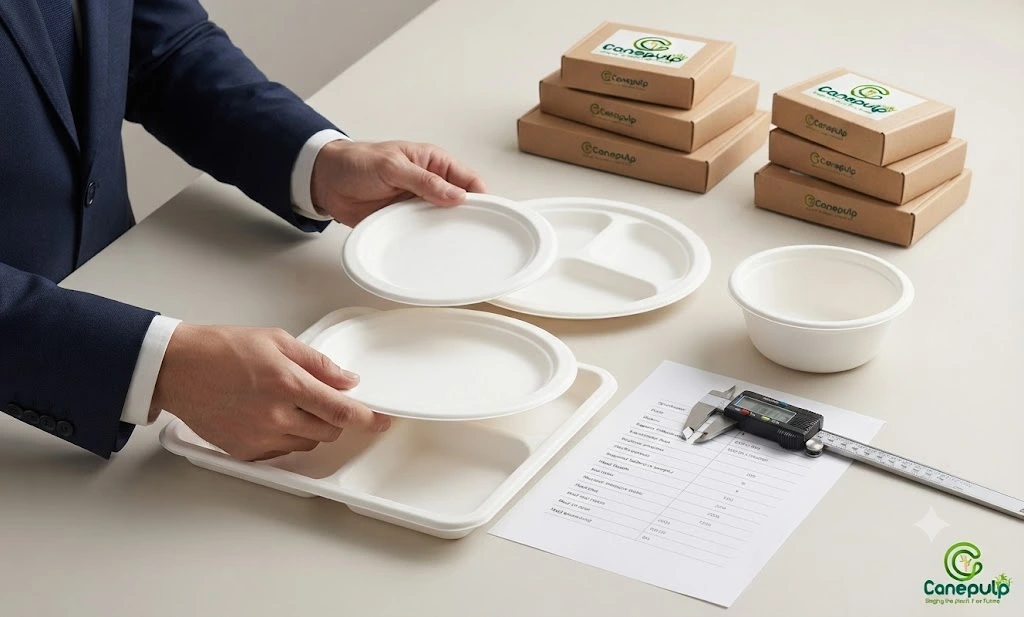
Buying from a bagasse tableware supplier is not just a unit-price decision. A bulk buyer needs to compare the actual product specification, sample quality, production capability, MOQ, packing method, quality-control process, and repeat-order reliability before committing to a large purchase. When only photographs, prices, or a generic catalogue are compared, a buyer can easily select a supplier that looks competitive on paper but underperforms in production consistency, carton packing, or commercial flexibility. For buyers purchasing recurring volumes, the right comparison starts with the approved sample and the written specification, not with a discounted quote alone.
1. Compare the Actual Product Specification
The first comparison should be the actual product specification. Ask for exact dimensions, diameter, depth, usable capacity, maximum load assumptions where relevant, number of compartments, material composition, thickness or strength information where measurable, and acceptable production tolerance for each SKU. This is especially important when comparing round plates, compartment plates, deep bowls, clamshell boxes, meal trays, and takeaway containers that may look visually similar but perform differently under real foodservice conditions.
The same stated size does not necessarily mean the same product performance. Two suppliers may both list a 10-inch plate or 500 ml bowl, but differ in weight, rigidity, edge finish, usable capacity, stackability, and long-term durability under hot or oily foods. A practical buyer should compare the approved sample against a written specification, not only against a catalogue image or a marketing photograph.
Ask how the supplier records variations between sample approval and production runs. A straightforward specification sheet should include product name, dimensions, target weight, sample reference, mould or tooling detail where relevant, and the acceptance criteria for visual defects, finish quality, and dimensional tolerance. This reduces the chance of misunderstandings when production starts or when repeat orders are placed months later.
2. Compare Samples Before Comparing Large Orders
A supplier should not be judged only by a good-looking sample. A real sample review should test the product against the buyer’s actual use case: how it handles hot food, oily food, soups, sauces, stacking in storage, and the planned service workflow. The right question is not simply “Does the sample look good?” It is “Does the sample perform the way we need it to when used in our operation?”
A practical sample checklist should cover dimensions, weight, finish, moulding quality, edge definition, rigidity, stacking behavior, usable capacity, and whether the product keeps its shape when hot or filled with heavier foods. For some foodservice buyers, the relevant test is not only whether the product holds up visually, but whether it performs consistently across multiple pieces from the same sample set.
If a supplier cannot explain how the sample was produced, how comparison samples are selected, or how production is monitored after approval, the risk of irregular supply increases. Buyers should request a sample evaluation against their required food-use scenario, not just a generic sample pack supplied as part of a sales conversation.
3. Compare Manufacturing Capability and Production Control
A bagasse tableware manufacturer should be evaluated on production capability, not just product range. Ask where the product is manufactured, whether production is handled in-house or through another supplier, how sample approval transitions to commercial production, and how the approved specification is communicated to the factory floor.
The right manufacturing questions are practical: what is the expected lead time for the sample, what is the production lead time for the order, how do revisions get communicated, and how are production changes tracked once the order is underway? For recurring or seasonal demand, the real comparison is whether a supplier can replicate the approved sample consistently over time and support subsequent reorders without drifting in finish, weight, or dimensions.
You can review the supplier’s broader manufacturing context through the manufacturing process and, where relevant, the manufacturer profile. Those pages help buyers understand the background of the operation, but the final decision should still be based on your supplier’s actual capabilities, sample performance, and quality track record.
4. Compare MOQ and Commercial Flexibility
MOQ should be reviewed in context, not as a single headline number. Compare MOQ by SKU, carton quantity, mixed-SKU ordering flexibility, private-label quantity, packing configuration, and repeat-order volume. A supplier with a lower MOQ might not be the lower-cost option if carton packing, freight, warehouse handling, or other commercial factors significantly change the final landed cost.
For buyers sourcing wholesale bagasse tableware, the key is to understand the full commercial structure: how many pieces are in each carton, whether cartons can be mixed, what shipping configuration fits the destination, and what packaging or documentation requirements affect the total cost. A batch that looks efficient on paper can become less attractive once freight, warehousing, or container utilization is factored in.
Before approval, ask how the MOQ fits your sales plan, replenishment rhythm, and product assortment. Buyers with seasonal demand or multiple SKUs often need more flexibility than a simple minimum stock figure suggests. That commercial flexibility should be discussed in the same review as specification, quality, and production schedule.
5. Compare Quality-Control Practices
When comparing a bagasse tableware supplier, review the quality-control process rather than relying only on a supplier’s general brand message. Ask what is inspected, when inspection happens, and which records are kept. Buyers should look at dimensional checks, weight consistency, visible defects, moulding quality, finish consistency, edge condition, and product strength or rigidity for the intended use case.
A strong quality conversation covers acceptance criteria, sample size, and what happens when a batch does not meet the approved specification. The buyer should know whether a supplier checks every production run or only random samples, and how defects are documented or corrected. This is especially important for recurring orders, because a supplier that passes one sample may still fail to maintain consistency across larger commercial runs.
Use the quality control page as background, then request the current inspection process that applies to the actual order. The goal is not to find a perfect supplier on paper; it is to ensure the supplier has a repeatable system for batch control and product approval.
6. Compare Packaging and Transit Protection
Packaging is a major part of export readiness. Compare pieces per carton, carton dimensions, net and gross weights, pallet configuration, carton strength, moisture protection where relevant, internal packing materials, stacking consistency, and cushion protection for fragile items or high-volume lines. These details matter when the products must travel long distances and remain in saleable condition when received.
A product can be correctly manufactured and still suffer commercial risk if the packaging is weak or not suited to the route. Many B2B buyers underestimate the impact of poor carton strength, load compression, or moisture exposure. For international orders, ask how the products are packed for transit and whether the packaging method was validated against the actual shipping route and expected handling conditions.
Before shipment, require the final packing list and confirm the target carton count, weight, dimensions, and shipping terms for the approved SKUs. Packaging review should be treated as part of the purchasing decision, not as a final administrative step after production is complete.
7. Compare Documentation and Market Requirements
Buyers should compare the documentation each supplier can provide for the product and destination market. Depending on the order, relevant documents may include product specifications, food-contact information where applicable, test reports, quality certification details, environmental statements, export documents, and any documentation required by the buyer’s importer or final market.
Do not assume that a supplier has regulatory coverage for every market. A safer approach is to request the actual product-specific documents and verify the issue date, scope, product description, and issuing authority. This is especially important for export orders, private-label projects, and buyers serving multiple territories with different documentation expectations.
The certifications page can help buyers understand the broader standards and documentation context, but the request should still be for the current documents relevant to the exact product, order, and destination market. Documentation should be validated against real compliance needs, not treated as a generic supplier claim.
8. Compare Lead Times and Replenishment Reliability
A supplier should not be judged only on the first sample or first order. Buyers should compare sample lead time, production lead time, dispatch time, and replenishment cycle for recurring orders. A supplier that delivers one good sample may still struggle to maintain the same specification and packing flow across multiple production batches, especially if the order volume rises or the product mix changes.
Ask how approved specifications are maintained between batches, how changes are communicated, and how repeat production is monitored. A disciplined supplier will be able to explain the production schedule, quality checkpoints, and communication process for ongoing replenishment. For operational buyers, that continuity matters as much as the initial sample quality.
This is one reason a supplier comparison should include repeat-order capability and communication quality, not just MOQ and unit price. Buying decisions for bulk supply should be based on the supplier’s ability to keep a stable commercial relationship over time, not only on an initial production win.
9. Compare Export and Private-Label Capability Where Relevant
For international or OEM buyers, a supplier comparison should also include export capability and private-label support if relevant. Consider export documentation, destination requirements, carton labeling, artwork approval, packaging approvals, tooling needs, repeat sample approval, and how the supplier handles export shipping. These questions matter whether the buyer is sourcing for a distributor network, supermarket chain, private-label program, or institutional foodservice account.
The export markets section can help buyers understand destination-specific requirements, and the private-label manufacturing guidance is useful when packaging or branding is part of the commercial program. The core point is to evaluate the supplier on the actual project requirements, not to treat export or OEM support as a generic add-on.
Bulk Order Buyer Checklist
- Product specification and tolerance
- Sample quality and real-use performance
- MOQ and commercial flexibility
- Packing and transit protection
- Quality-control process
- Documentation and certifications
- Lead time and replenishment reliability
- Export capability and shipment documentation
- Private-label or OEM capability where relevant
- Communication and repeat-order consistency
What to Discuss With a Bagasse Tableware Supplier
Before choosing a supplier, request product specifications, sample requirements, MOQ detail, carton and shipping requirements, quality-control information, and documentation relevant to your market. Ask the same questions across every supplier so the comparison is fair, objective, and based on actual commercial risk.
A strong bulk bagasse tableware buying decision comes from comparing suppliers on real project criteria: product specification, sample performance, manufacturing capability, packing quality, quality control, documentation, and repeat-order reliability. The supplier that offers the best balance of specification clarity, commercial flexibility, and predictable supply is usually the better B2B partner, even when the initial quoted price is not the lowest. Compare each supplier with the same checklist and let your approved sample and written specification guide the decision.