

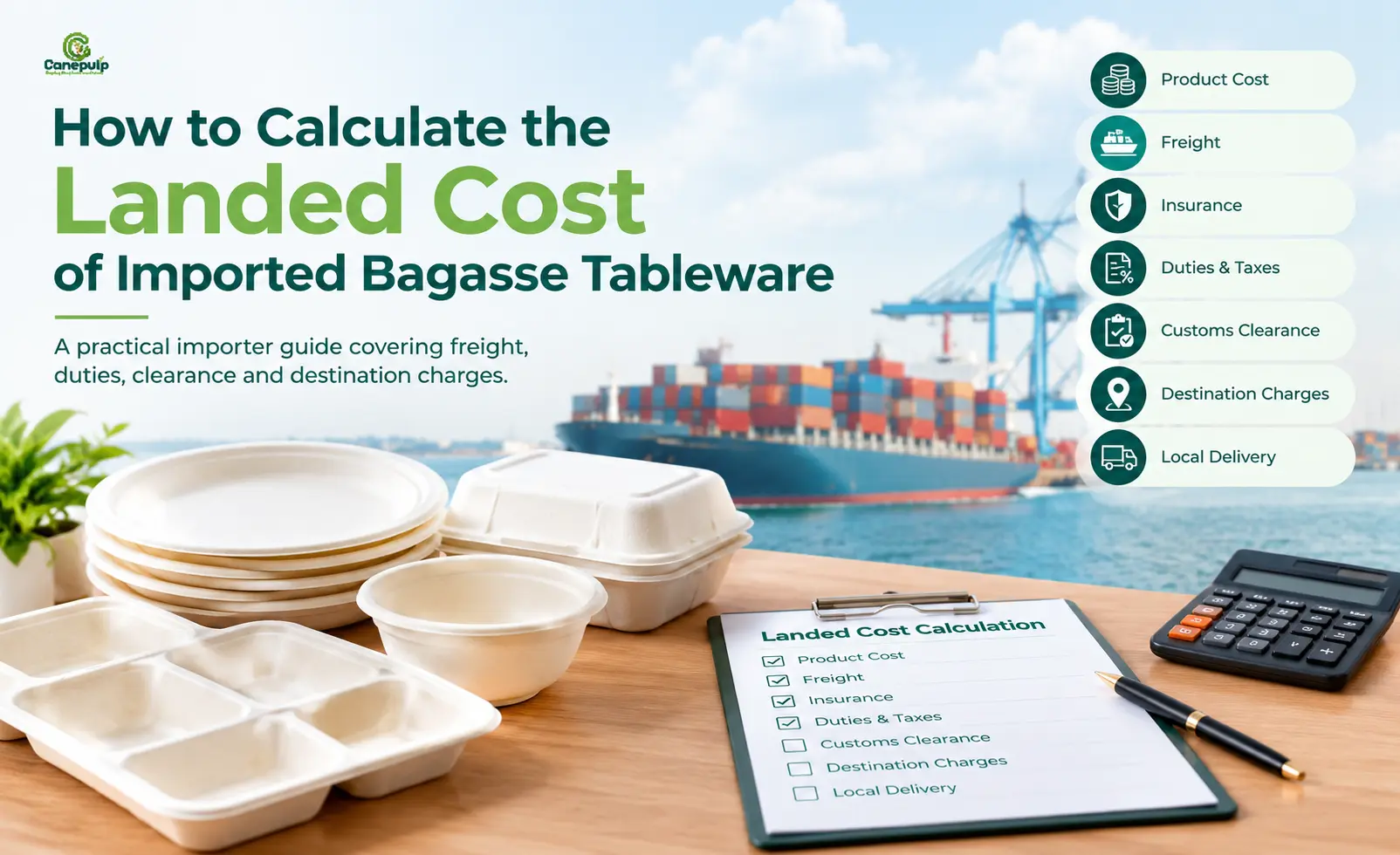
The supplier’s quoted product price is not always the full cost of an import purchase. A B2B buyer who wants to compare offers accurately needs to understand the total landed cost: the real cost of the product after freight, packing, insurance where applicable, customs duties and taxes, customs clearance, destination handling and local delivery. For bagasse tableware, the landed cost can change significantly depending on the seller’s Incoterm, the shipment mode, the carton configuration, the destination market, and the customs or port costs that apply to the actual order.
1. Start With the Supplier’s Product Cost
The commercial calculation normally begins with the supplier’s product cost. In its simplest form, product cost is computed as unit price multiplied by order quantity. For example, if a buyer orders 10,000 pieces at $0.08 per unit, the product value is $800 before freight and other import costs. This is an illustrative example only and not a Canepulp price or current market rate.
Before accepting the product value, the buyer should still verify the exact SKU, product dimensions, weight, carton structure, carton quantity, MOQ, approved specification, and packing configuration. Those details are not just administrative. They affect the real shipping cost and the way the goods are loaded, handled and compared with other offers.
This step also matters because a buyer should compare the same product under the same conditions. If two suppliers are offering different SKUs, different carton counts, or different packing assumptions, the product cost alone is not enough to make a fair comparison. The landed cost calculation has to start from the same commercial basis.
2. Understand the Incoterm Before Calculating
The Incoterm is one of the first items a buyer should review because it determines how cost responsibility is allocated. Common examples include EXW, FOB, CIF, DAP and DDP. The exact meaning of each term should be interpreted in the context of the actual quotation and commercial agreement, and the buyer should not assume all suppliers use the same allocation model.
A simple way to think about it is that the Incoterm clarifies which costs remain with the supplier and which costs become the buyer’s responsibility as the goods move through the shipping process. For example, under EXW, the buyer may remain responsible for a larger share of transport and export handling, while under CIF or DAP the quoted value may include some freight and delivery responsibilities. The buyer should know exactly what the supplier quotation includes before adding costs to the calculation.
For a practical comparison, it is useful to ask the supplier to confirm the quotation basis and the cost responsibilities at every stage. That makes the landed-cost calculation more predictable and prevents later surprises from origin handling, destination delivery or customs clearance.
3. Add Freight and Transportation Costs
Freight is often a major part of the true landed cost for imported bagasse tableware. Buyers may need to consider origin inland transport, export handling, freight by ocean or air where relevant, destination port handling, local delivery and any carrier or terminal charges. The exact combination depends on the shipment route, the destination country, the order size and the Incoterm used in the quotation.
For lightweight but bulky products, volume and container utilization can matter as much as weight. Bagasse tableware often occupies a meaningful amount of carton volume relative to product weight, so a buyer should assess whether the shipment will move by LCL, FCL, or another configuration. This can affect handling costs, storage costs and the final shipping price. A product that looks cheap at the factory can become less competitive after freight and handling are added.
The buyer should always ask for the freight basis, the shipping mode, and the cost assumptions behind the quotation. That information is essential to a serious landed-cost estimate, even if the exact freight rate changes as market conditions or routing change.
4. Calculate Customs Duties and Import Taxes
Customs duties and import taxes can change the landed cost significantly, and they depend on the destination country, the product classification, the declared customs value, and local trade rules. Bagasse tableware is not always treated the same way across every market, which is why a buyer should not assume a universal duty rate or a single tax percentage applies to every shipment.
The safest approach is to confirm the applicable customs rules with the destination country’s customs authority, customs broker or qualified importer. The buyer should understand the difference between a customs duty, import tax and any local charges that may apply at the border or during import clearance. These are not always the same cost category, and they should not be combined without checking the actual customs treatment for the shipment.
This is a practical area where buyers should avoid guessing. It is better to request the customs basis and local duties for the exact product, country and import structure than to assume a rough estimate and accidentally under-budget the landed cost.
5. Add Customs Clearance and Destination Charges
Beyond the base duty or tax, the importer may also need to budget for customs clearance fees, broker fees, destination handling, port charges, local transport and other administrative costs. Depending on the destination and shipment arrangement, there may also be storage, demurrage, inspection or document-related charges if shipment timing or customs processing becomes more complex.
The important point for a procurement team is that a landed-cost estimate should include all buyer-side costs that arise after the supplier plus shipping stage. If a buyer does not include a realistic customs clearance or local delivery assumption, the calculation is incomplete. This is a common reason a product can appear more economical than it really is once the shipment reaches its final destination.
The buyer should ask whether the supplier quotation includes all post-shipment costs or whether those costs are the buyer’s responsibility. That clarification is essential before an order is approved or an importer commits to a commercial purchase.
6. Calculate the Total Landed Cost
A practical formula for import planning is: Landed Cost = Product Cost + Freight + Insurance Where Applicable + Duties and Taxes + Customs Clearance + Destination Charges + Local Delivery + Other Applicable Import Costs. Once the total landed cost is known, the buyer can also calculate the landed cost per unit by dividing the total by the number of saleable pieces in the order.
Here is an illustrative example only: if the product value is $800, freight and logistics are $500, duties and taxes are $150, customs clearance and destination charges are $100, and local delivery is $50, then the total landed cost is $1,600. If that order includes 10,000 pieces, the landed cost per piece is $0.16. This example is only for illustration and should not be treated as a current market rate or a Canepulp quotation.
The value of this formula is that it forces buyers to compare the full commercial picture rather than just the product price. It gives a clearer answer to the question: “What will the order actually cost me after the item arrives at the destination?” That is the most relevant commercial question for a global import buyer.
7. Don’t Forget Carton Volume and Container Utilization
Bagasse tableware buyers should not evaluate only the unit price. They should also review the carton specification, pieces per carton, pallet configuration, gross weight, net weight, total shipment volume and the likely container or shipping configuration. A lower unit cost can be less attractive if the product is packed inefficiently or if the carton count creates poor container utilization.
This is especially relevant for bulk orders or container shipments. A product with a low product cost but poor packing density may create higher shipping cost per unit. A buyer should therefore review the total shipment profile as well as the supplier’s unit-price quotation. This is a practical strategy for comparing two offers fairly and for understanding the real shipping cost of the purchase.
Buyers can ask the supplier for carton dimensions, carton weights, and the expected shipment profile so they can calculate cost of freight and landing in a more realistic way. Without this information, the landed cost estimate may be incomplete or misleading.
8. Compare Suppliers Using Landed Cost, Not Factory Price
A sound supplier comparison should use the same set of assumptions. The buyer should compare product price, packing configuration, Incoterm, shipping mode, destination costs, duties and taxes, and local delivery on the same basis. If the comparison is made using different Incoterms or different carton calculations, the conclusion is not reliable.
A useful comparison table may list each cost component side-by-side, including product cost, packing, origin logistics, freight, insurance, duties, customs clearance, destination charges and local delivery. That allows the buyer to see whether a supplier with a slightly higher product price is actually cheaper after the shipment reaches the destination. A supplier that looks better on product price alone is not necessarily better on total landed cost.
This is the heart of procurement decision-making: compare the total commercial picture rather than just the factory or product price. That is what makes the landed-cost review valuable for B2B buyers, importers and distributors.
9. Questions to Ask a Bagasse Tableware Supplier Before Ordering
A buyer can make a more accurate landed-cost estimate by asking a few practical questions before confirming the order. For example: what is the exact product price, what does the quotation include, which Incoterm is being quoted, how many pieces are in each carton, what are the carton dimensions, what is the gross weight and net weight, which documents will be provided, what shipping mode is recommended, and which charges remain the buyer’s responsibility after the goods leave the supplier? These questions are simple but they reveal whether the buyer is comparing two truly comparable offers.
The buyer should also confirm the approved specification and the expected shipment structure. Without the approved product reference and a realistic shipment plan, it is difficult to calculate the true landed cost. This is especially important for container orders, mixed-SKU shipments, and destination-specific distribution plans.
Bulk Order Buyer Checklist
- Product cost confirmed
- Incoterm clarified
- Freight basis reviewed
- Insurance checked where applicable
- Customs duties and import taxes reviewed
- Customs clearance costs considered
- Destination charges considered
- Local delivery included
- Carton and volume assumptions reviewed
- Landed cost per piece calculated
Build a More Accurate Bagasse Tableware Import Budget
Request the product specification, carton details, shipping terms and quotation needed to calculate the true landed cost before approving a commercial order.
The landed cost of imported bagasse tableware is the real commercial benchmark for any B2B buying decision. The buyer should not compare only the supplier’s product price. They should compare the full calculation: product cost, freight, insurance where applicable, duties and taxes, customs clearance, destination charges, local delivery and all other applicable import costs. Once those components are added together and divided by the order quantity, the buyer gets a much more reliable estimate of the real cost of the shipment.