

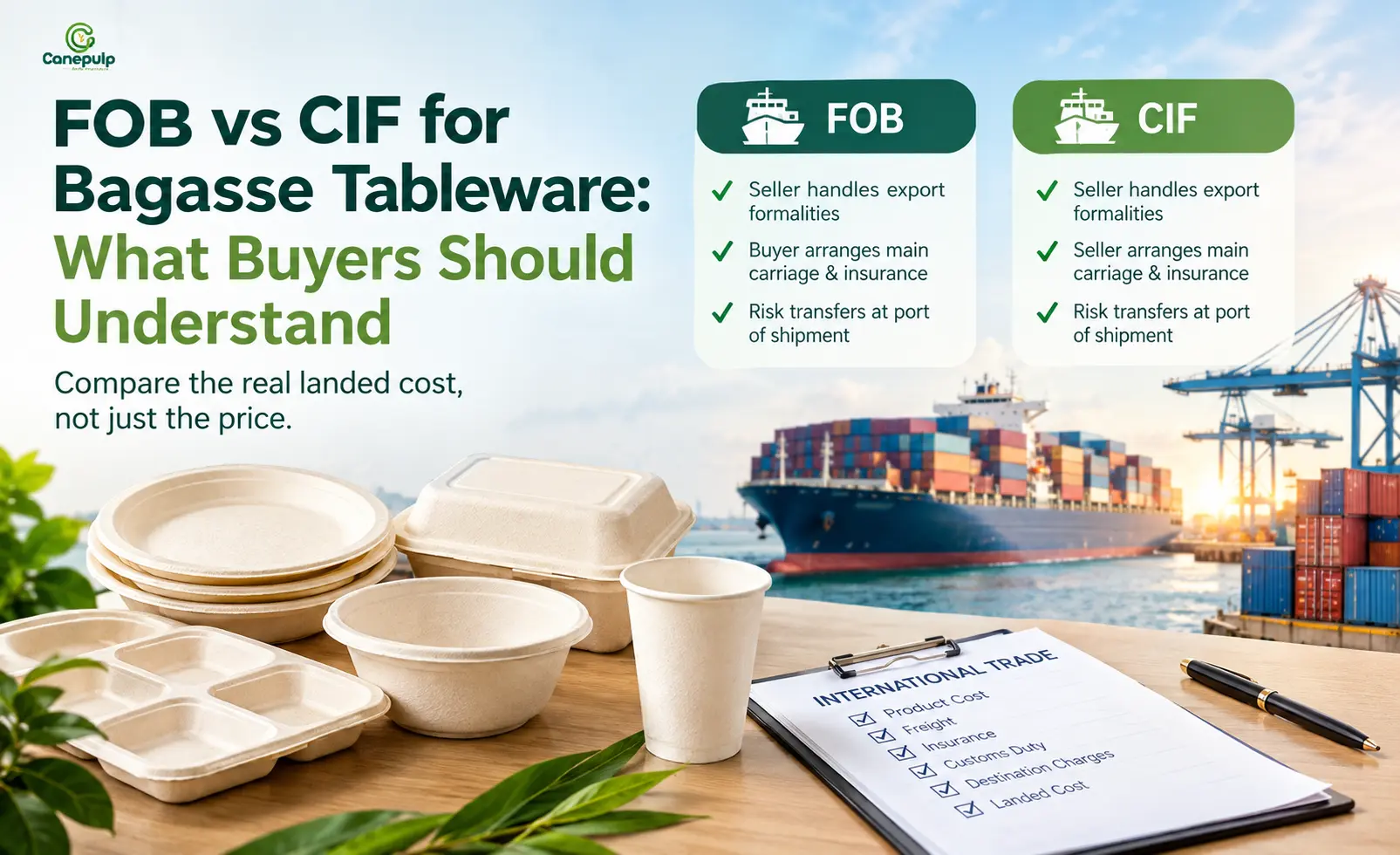
A buyer reviewing two quotations for the same bagasse tableware order may see one price quoted as FOB and another as CIF and assume the higher number is the more expensive option. That is not always true. In international sourcing, the issue is not simply the headline number. Buyers need to understand what the quotation includes, who arranges the shipment, who pays for insurance, when risk transfers, and what costs remain payable at the destination. That is the difference between comparing a supplier quote and comparing the real landed cost of the order.
FOB vs CIF at a Glance
| Point | FOB | CIF |
|---|---|---|
| Main transport mode | Sea/inland waterway | Sea/inland waterway |
| Seller arranges export formalities | Yes, in line with the agreed contract and export process | Yes, in line with the agreed contract and export process |
| Main carriage arranged by | Buyer | Seller |
| Insurance arranged by | Buyer | Seller, under CIF insurance obligations |
| Risk transfer | When goods are placed on board the vessel at the agreed port of shipment, subject to the contract and transport arrangements | Typically when goods are placed on board the vessel at the port of shipment, subject to the contract and transport arrangements |
| Destination charges | Often remain with buyer, depending on destination and contract | Still often remain with buyer after the named destination port, depending on the contract and destination requirements |
| Best understood as | Buyer-arranged main carriage | Seller-arranged carriage and insurance to the named destination port |
Under the International Chamber of Commerce Incoterms framework, both FOB and CIF are sea or inland waterway terms. They are not interchangeable, and they are not just different labels for the same commercial arrangement. The key difference is who arranges the main carriage and the insurance element, and which costs remain the buyer’s responsibility after the shipment leaves the origin port.
A common mistake is to treat CIF as a guarantee that the seller is responsible for every cost, risk, and destination charge until the buyer receives the goods. That is not how the term works. CIF includes the seller arranging the main carriage to the named destination port and obtaining insurance covering the required CIF risk. It does not automatically mean the seller is paying all import duties, customs clearance, inland delivery, unloading, warehousing or every other destination-side cost that may arise under the import arrangement.
What Does FOB Mean for a Bagasse Tableware Buyer?
FOB is a common term in international bagasse tableware trade, especially when a buyer wants direct control over freight and shipping decisions. Under FOB, the seller delivers the goods when they are placed on board the vessel at the agreed port of shipment. That means the seller’s delivery obligation is tied to the point of shipment, and the buyer then manages the main carriage from the origin port onward.
In a realistic scenario, a buyer may place a bulk order for bagasse plates or bowls from an Indian supplier. The supplier prepares the goods, arranges export packaging, and handles the export process. The goods move to the origin port, and when they are loaded on the vessel, the buyer’s responsibility for the ocean shipment begins according to the contract and shipment arrangement. The buyer then arranges freight, booking, shipment coordination, import documentation, and destination-side logistics unless those responsibilities are otherwise allocated by contract.
This is whyFOB can be attractive for importers with established freight arrangements. The buyer may have preferred forwarders, existing shipping partners, or more direct control over cost and arrival planning. The buyer also has more control over the shipping route, booking timing and freight negotiations. At the same time, the buyer takes on more responsibility for the freight stage, destination port planning, and any logistics costs that follow the vessel movement.
For a bagasse tableware buyer, FOB can be valuable when the product specification is already clear, the order volume is known, and the buyer wants to manage shipping decisions based on their own import flow. The real commercial question is not whether FOB is “better,” but whether the buyer is prepared to manage the cost and operational logic of the main carriage from the origin port.
What Does CIF Mean for a Bagasse Tableware Buyer?
CIF is still a sea or inland waterway term, but under CIF the seller arranges the main carriage to the named destination port and obtains the insurance required under the term. This can be useful when a buyer wants the supplier to handle more of the shipping coordination, especially when the supplier is already working with an export freight arrangement or shipping partner.
A bagasse tableware buyer may receive a CIF quotation that includes the product cost and the freight to the destination port, with the seller also arranging the insurance required by CIF. That does not automatically mean the buyer is free of all additional destination costs. Customs duties, taxes, clearance, inland delivery, terminal handling, warehousing, and other local charges may still be payable depending on the destination, contract and logistics chain.
This is where risk and cost are often confused. Under CIF, the seller’s cost responsibility extends to the main carriage and required insurance up to the named destination port, but the risk transfer is still governed by the Incoterm and the agreed transport arrangement. In other words, the seller is responsible for arranging the freight and insurance to the named destination port, but a buyer should not assume that the seller remains responsible for every cost or every risk beyond that point simply because the quotation says CIF.
CIF can make sense for importers who want a more bundled quotation, but that convenience should be compared carefully with the buyer’s actual destination costs. The buyer should still ask exactly what the CIF quotation includes and what additional import charges remain to be paid after the shipment reaches port or the destination area.
FOB vs CIF — Which Costs Should You Compare?
The important comparison is not FOB price against CIF price as if those numbers were directly comparable. A buyer should compare the full commercial cost of the order, not just the origin factory value. The real decision should be based on the buyer’s practical landed cost, which includes the product price, origin handling, freight, insurance where applicable, customs duties and taxes, customs clearance, destination charges and inland delivery.
A better starting question is: “What will this order cost me when it reaches my actual import destination?” That means the buyer should normalize the quotation and inspect every cost component. A supplier might offer a lower FOB value, but the buyer may still pay more in ocean freight, destination terminal charges, customs clearance and local transport. Conversely, a CIF quotation may look more expensive at first glance but might be more convenient or comparable once the buyer accounts for freight and insurance management.
The cost comparison should therefore include the order quantity, carton configuration, shipment volume, loading method, destination port, local duties or taxes, and shipping route. For bagasse tableware, volume efficiency matters because the goods can be bulky relative to their weight. That can affect freight cost and ultimately the buyer’s final per-unit landed cost.
This is why buyers should compare quotations on the same basis. A proper procurement review asks: What exactly is included, what is excluded, what is the named port, who arranges the freight, who arranges the insurance, which destination costs still apply, and what is the estimated landed cost after all buyer-side costs are added? Without that clarity, the comparison is not yet commercially reliable.
Example — Comparing an FOB and CIF Quotation
The following example is illustrative only and not a real Canepulp quotation or current market price. A buyer is sourcing 10,000 pieces of bagasse tableware. Supplier A quotes an FOB price of $0.18 per piece. Supplier B quotes a CIF price of $0.22 per piece to a named destination port. On paper, Supplier A looks cheaper. But the buyer has to add the costs of arranging the ocean freight from the origin port, cargo handling, and destination-side import costs. If the buyer’s freight and logistics cost is $1,200, insurance and related origin charges are $200, and destination import charges are another $900, then the total cost under the FOB route becomes more expensive than it first appears. Supplier B’s CIF price may include the freight and insurance to the destination port, but the buyer still needs to calculate duties, local customs clearance and inland delivery if those charges are not otherwise covered by the commercial arrangement.
The key lesson is that the lower-looking quotation is not automatically the lower landed-cost option. A buyer should always build the total cost model before deciding. That includes the product price, shipping arrangement, insurance, customs duties or taxes, destination charges, inland transport and any destination-side handling not covered by the quotation. Once those items are accounted for, the buyer can decide which quotation is actually more favorable for their order and import route.
This is one of the best reasons to review quotations with a procurement mindset rather than a headline-price mindset. A supplier quote should be assessed against the buyer’s actual import plan, not only against a comparison of the numbers on the first page of the quotation.
What CIF Does Not Automatically Include
This is a very important point for B2B importers. A CIF quotation does not automatically mean the seller pays for all import-related charges after the shipment arrives at the named destination port. Depending on the contract, port, customs practices, carrier arrangements and local logistics, additional charges may still apply. These can include import customs clearance fees, duties or taxes, destination inland transport, port handling, local warehousing, unloading, or other charges linked to the destination market.
The buyer should not assume that CIF means “everything included until the goods arrive at my warehouse.” That is not a correct reading of the term. The name of the destination port matters, as do the actual commercial terms agreed with the supplier. The buyer should ask precisely what is included in the CIF offer and what remains with the buyer after the goods reach the named destination port or other agreed point in the customs/import chain.
This is also why the buyer should confirm the named destination port, the shipment basis, and the destination-side responsibilities before signing a purchase order. A well-managed quotation comparison includes both the seller’s cost responsibilities and the buyer’s cost responsibilities. The goal is to calculate realistic landed cost, not just to interpret a shipping term by abbreviation or a supplier’s sales summary.
When Should a Buyer Consider FOB?
FOB is often relevant when the buyer already has a freight strategy. Buyers with established shipping routes, preferred logistics partners, or ongoing import operations may prefer FOB because it gives them more direct control over the main carriage, shipment timing and freight negotiation. This control can be useful when the importer is familiar with container logistics or when a company is consolidating many cargo movements through its own process.
FOB can also make sense when the buyer wants to compare shipping options and choose the most effective route for a given order or destination market. If the buyer has a well-established freight structure, FOB offers flexibility and often gives the buyer more visibility into the cost and planning of the ocean shipment itself. The buyer is still responsible for the freight and related logistics beyond the origin port, but that is the arrangement they have chosen for their own import process.
It is not a case of FOB being “better” in every scenario. It is simply a commercially relevant option when the buyer is organized to manage the shipping stage directly and wants to align the freight decision with their own import process and carrier preferences.
When Should a Buyer Consider CIF?
CIF may be useful when the buyer wants the supplier to arrange the main carriage and provide insurance to the named destination port. This can simplify the commercial arrangement for an importer who wants a more bundled quotation and is less focused on managing the shipping booking directly. It may also be helpful when the supplier is already shipping regular export cargo and can coordinate the route more efficiently.
The buyer should still review the CIF quotation carefully and ask what remains at the buyer’s side after the goods reach the named port. The supplier may be taking responsibility for freight and insurance to a certain point, but the buyer may still be responsible for destination customs clearance, duties, local transport and any final logistics charges. The correct commercial question is not simply “Is CIF easier?” but “What does this CIF quotation include, and what will I still pay after the cargo reaches port?”
For many buyers, the decision comes down to risk management and operational convenience. FOB gives more direct control, while CIF can reduce the number of moving parts the buyer must coordinate. Both are legitimate trade terms, and neither is automatically superior in every procurement situation.
Questions to Ask Before Accepting a Bagasse Tableware Quotation
- Which Incoterm is quoted: FOB or CIF?
- What is the exact named port or destination point?
- What costs are included in the quotation?
- What costs remain payable at destination?
- Who arranges the main carriage?
- Who arranges the insurance?
- What is the shipment volume and expected carton configuration?
- Are customs duties or taxes excluded or included?
- Who handles export documentation and import clearance?
- What documents will be issued with the shipment?
- What is the lead time and order validity?
- Has the product specification been confirmed before the order is released?
These questions are straightforward, but they protect the buyer from confusing a seller’s shipping term with the real commercial burden of the transaction. In international procurement, quotations are most useful when they are normalized against the buyer’s import plan and the destination market’s logistics and customs realities.
FOB vs CIF for Bagasse Tableware Imports From India
When sourcing bagasse tableware from India, the buyer should compare the same basis across suppliers. A supplier quoting FOB from an Indian port should be reviewed against the buyer’s own shipping arrangements, while a CIF quotation should be reviewed against the additional destination-side fees that may remain payable. The right comparison is not “who has the cheaper number on paper,” but “who can deliver the required product and shipment terms at the lowest practical landed cost for my specific import route.”
This is where a buyer’s operations matter. An importer with established freight networks may prefer FOB and manage the shipment directly. A buyer who wants a simpler quote may prefer CIF, but should still ask for a full breakdown of what is included and excluded. If the supplier is operating as an export-focused manufacturer or exporter, a review of their broader export context such as the export markets guidance and the manufacturer profile can help put the commercial discussion in context without turning the article into a sales page.
The fundamental issue is the same for every order: whether the buyer understands the legal, cost and risk position under the quotation before the purchase is confirmed. That is the decision-making framework that matters most when buying bagasse tableware internationally.
Final Buyer Checklist
- Confirm the Incoterm and exact port
- Confirm product specification and quantity
- Confirm carton packing and volume assumptions
- Confirm who arranges freight and insurance
- Confirm whether destination charges are included
- Confirm customs duties and taxes
- Confirm inland delivery and local handling
- Confirm documentation and shipment recording
- Calculate landed cost before final approval
- Keep the approved quotation and specification together as the commercial reference
FAQ
What is the difference between FOB and CIF? FOB means the buyer arranges the main carriage from the named port of shipment, while CIF means the seller arranges carriage to the named destination port and obtains the insurance required under CIF. Both are sea/inland waterway Incoterms, and they differ in responsibility for freight and insurance.
Is CIF always more expensive than FOB? Not necessarily. CIF may include freight and insurance in the supplier quote, but the buyer still has destination-side charges to review. The better option depends on the shipment structure, the named port and the buyer’s actual landed cost.
Does CIF include customs duty? No, CIF does not automatically mean the seller pays destination customs duty, destination taxes or all other import-related charges. A buyer should check the exact commercial terms and the destination customs requirements.
Who pays for insurance under CIF? Under CIF, the seller arranges the insurance required by the term. The buyer should still confirm the insurance scope, the named destination port, and any additional charges that may remain outside the CIF arrangement.
Which Incoterm should I use when importing bagasse tableware? There is no universal rule. The right term depends on the buyer’s shipping setup, freight strategy, importer experience, destination market and commercial risk preferences. The key is to compare quotations on the same basis and calculate the real landed cost.
Bulk Order Buyer Checklist
- Incoterm confirmed
- Named destination port confirmed
- Product specification verified
- Freight responsibility clarified
- Insurance responsibility clarified
- Customs duties and taxes reviewed
- Destination charges checked
- Documentation requirements reviewed
- Practical landed cost calculated
- Commercial quotation normalized before approval
Compare the Real Cost Before You Approve the Shipment
Before accepting a FOB or CIF quotation for bagasse tableware, confirm the named port, the freight and insurance responsibilities, and the destination charges that will still fall to the buyer.
FOB and CIF are both useful Incoterms, but they are not equivalent commercial arrangements. For bagasse tableware buyers, the key is to understand the actual responsibilities for freight, insurance, risk transfer and destination-side costs before accepting a quotation. A lower headline price may not mean a lower landed cost, and a CIF quote may not mean the seller is covering every import or destination charge. The better decision is the one based on the total landed cost of the order and the buyer’s real import plan.